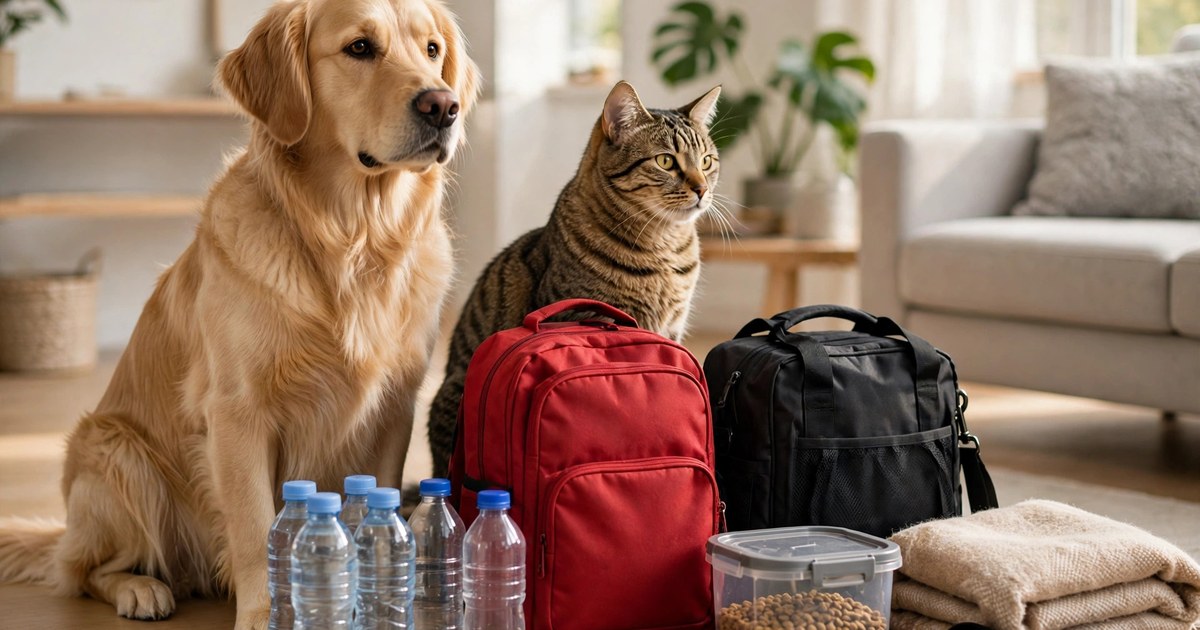
Storms, wildfires, floods and long power cuts rarely give much warning. When an evacuation order comes, you may have ten minutes to leave — and your dog or cat cannot pack for themselves. A pet emergency kit is one bag, packed in advance, holding everything your pet needs until life returns to normal.
This guide gives you a complete 20-item checklist for dogs and cats, exact food and water quantities, home kit vs go-bag, and a 30-minute plan to build yours today. It follows guidance from the ASPCA, the American Red Cross and the American Veterinary Medical Association.
What Is a Pet Emergency Kit?
A pet emergency kit is one clearly labelled bag or box holding your pet's essentials for at least three days away from home — ideally two weeks of food and water stored at home. It has two parts: a larger home kit for sheltering at home, and a lighter go-bag you can grab in under a minute when you must evacuate. Build the home kit first, then pull the go-bag from it.
The 20 Must-Haves: Your Pet Emergency Kit Checklist
Tick each item off as it goes into the bag — a kit with 19 of 20 items is still a kit with a gap.
Food and water (items 1–4)
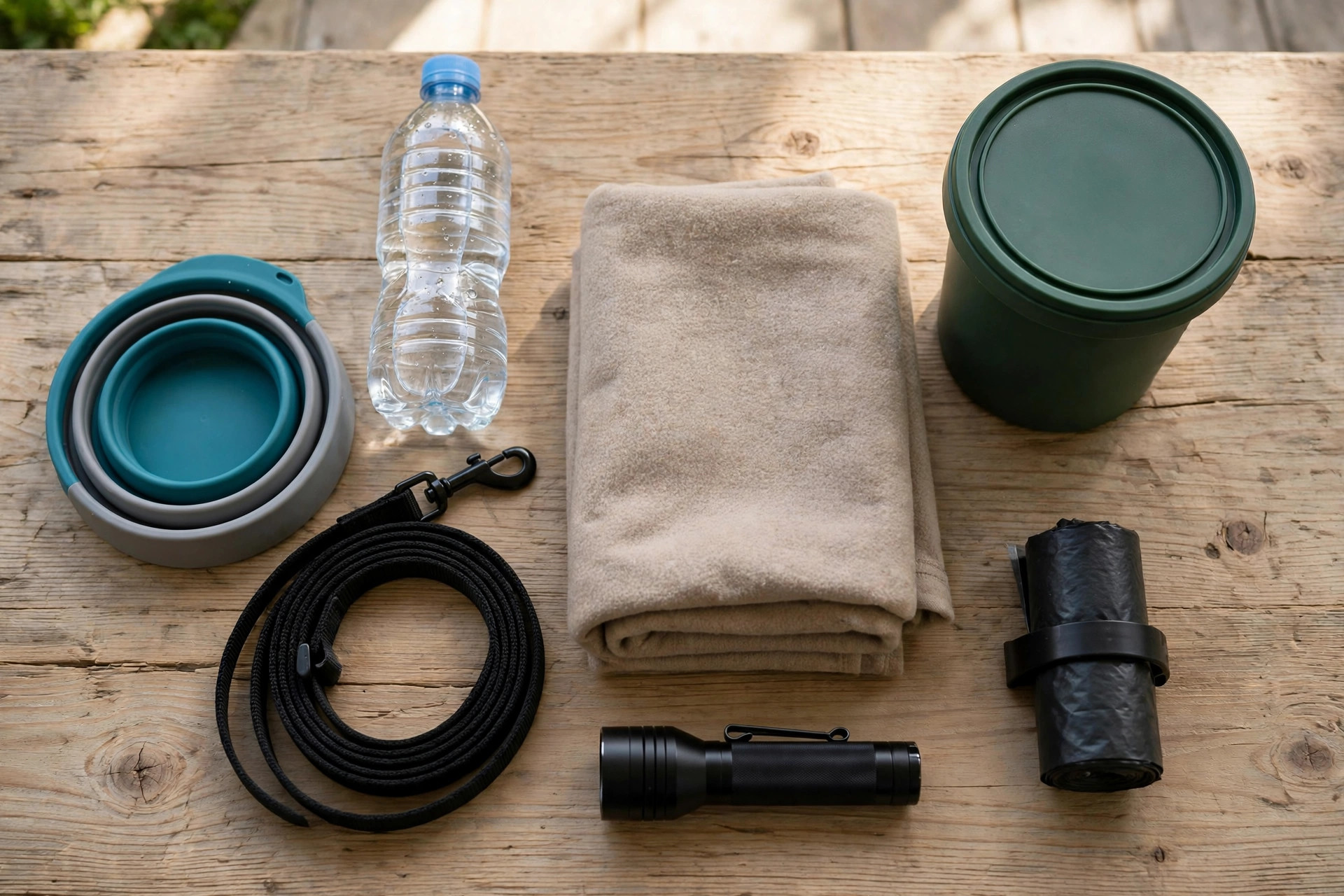
- 1. Your pet's usual food — three days in the go-bag, two weeks at home, in a sealed waterproof container. Never switch brands in a crisis.
- 2. Bottled water for your pet — separate from your family's supply (quantities below).
- 3. Collapsible food and water bowls — one set per pet. They weigh almost nothing and save real space.
- 4. A manual can opener — only if you feed canned food; electric openers fail in a power cut.
Documents and identification (items 5–8)
- 5. Vaccination records and vet history — paper copies in a waterproof zip bag, plus phone photos. Shelters often require proof of vaccination.
- 6. Microchip number and registration details — only useful if your contact details are current with the registry. Check yearly.
- 7. A recent photo of your pet — ideally one of you together, to prove ownership if separated. Print it; a dead phone shows nothing.
- 8. Any medication your vet has prescribed — a two-week supply in its original packaging, plus a copy of your vet's written instructions.
Transport and safety (items 9–11)
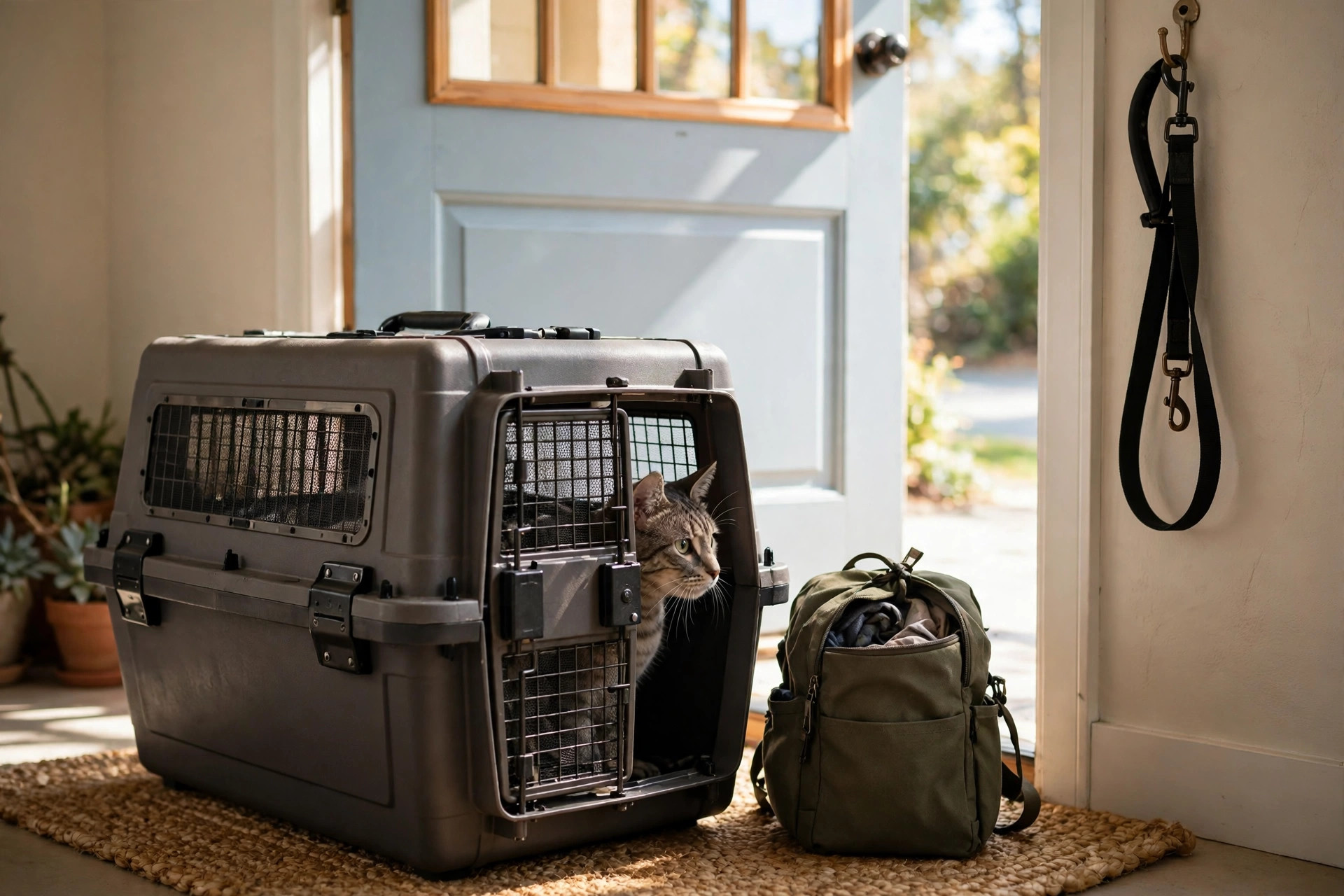
- 9. A carrier that fits — your pet should stand and turn inside it. Keep it within reach. Many shelters will not accept a loose cat.
- 10. A spare leash, collar and harness — with a current ID tag. Leashes break at the worst moments.
- 11. A flashlight with spare batteries — for night evacuations and finding a pet hiding under a bed.
Comfort and sanitation (items 12–16)
- 12. A familiar blanket or bedding — the smell of home calms a frightened pet more than anything you can buy.
- 13. A favourite toy or comfort item — one small toy. Familiarity matters when everything else is strange.
- 14. Waste bags for dogs — at least a full roll, plus paper towels.
- 15. Cat litter and a disposable tray — a small bag of litter and a foil tray make a hotel or shelter stay manageable.
- 16. Cleaning supplies — paper towels, trash bags and pet-safe wipes. Ask your vet before packing disinfectant — some cleaners are hazardous to animals.
First aid and contacts (items 17–20)
- 17. Basic pet first-aid supplies — gauze, non-stick bandages, blunt-ended scissors, tweezers and a thick towel in a labelled pouch. Ask your vet to show you how to use them.
- 18. Your vet's contact details — written on paper, not only in your phone: your vet and the nearest 24-hour emergency animal hospital.
- 19. A list of pet-friendly places — two or three hotels, boarding facilities or friends' homes outside your area that accept pets.
- 20. Your emergency contact's details — a trusted person who can collect your pet if you cannot get home. Give them a key in advance.
How Much Food and Water Should You Pack?
The CDC recommends a two-week supply of food and water for each pet at home, while the ASPCA suggests a week to ten days or more for a go-bag. Use this table as a guide.
| Pet | Water per day | Go-bag (3 days) | Home kit (2 weeks) |
|---|---|---|---|
| Small dog (up to 20 lb) | About 2–3 cups | 3 days of food + 1 gallon | 2 weeks' food + 7 gallons |
| Medium dog (20–50 lb) | About 3–6 cups | 3 days of food + 2 gallons | 2 weeks' food + 14 gallons |
| Large dog (50 lb and over) | About 6–12 cups | 3 days of food + 3 gallons | 2 weeks' food + 21 gallons |
| Average cat (about 10 lb) | About 1 cup | 3 days of food + 1 quart | 2 weeks' food + 2 gallons |
As a rule of thumb, dogs drink roughly 1 ounce of water per pound of body weight per day, and cats need far less. Round up rather than down — active dogs, hot weather and dry food all push the numbers up. Rotate stored water every six months.
Home Kit vs Go-Bag: What Goes Where?
Keeping everything in one giant bag sounds simple, but a two-week food supply is too heavy to carry. Split it:
- Home kit (stays put): two weeks of food and water, spare litter and waste bags, extra blankets, a spare carrier, and copies of all documents. Store it in one labelled box within easy reach.
- Go-bag (grab and go): three days of food and water, the document pouch, medication, leash or carrier, one blanket, one toy, waste bags or litter, flashlight, and the contact list. Keep it by the door or in the car boot — never buried under other luggage.
Evacuating? Take the go-bag. Sheltering at home? Use the home kit — no trip to the shops needed.
Build Your Kit in 30 Minutes
You do not need a shopping trip to start. Most households already own 80% of this list.
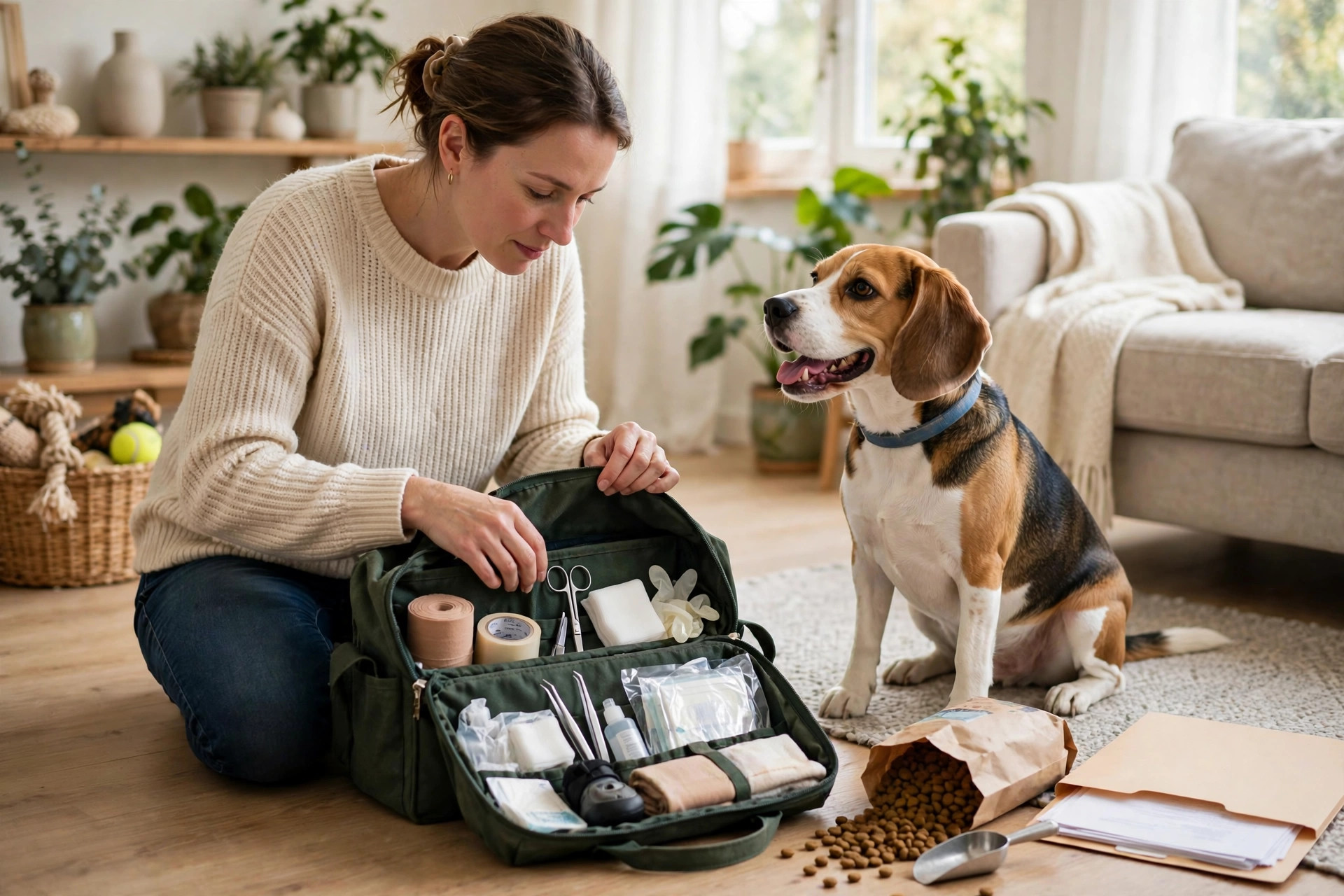
- Pick the bag (5 minutes). A sturdy backpack or labelled plastic box with a lid. Mark it "PET EMERGENCY KIT" so anyone can find it.
- Gather what you already own (10 minutes). Walk the house: spare leash, old blanket, flashlight, bowls, waste bags, towel.
- Make the document pouch (5 minutes). Copy vaccination records, write down the microchip number and vet numbers, and add a printed photo of your pet. Seal it in a zip bag.
- Add food and water (5 minutes). Three days of food in a sealed container and bottled water. Check the use-by dates before packing.
- Buy the gaps (one short trip). Whatever is missing — usually a carrier, collapsible bowls or a first-aid pouch — goes on one shopping list.
- Store it and tell the household (5 minutes). Put the go-bag by the door, the home kit in its spot, and tell everyone in the house where both are.
Keep It Fresh: A Simple Rotation Schedule
Check the kit twice a year, when the clocks change. Every six months, check use-by dates, rotate food and water, test the flashlight, replace dead batteries and update the photo. Once a year, confirm the microchip registration, check the carrier still fits and refresh the hotel list. After any use, restock the same week.
Your Evacuation Plan in 5 Steps
A kit without a plan is only half the job — write this down and keep it with the document pouch.
- Know your triggers. Decide in advance what would make you leave — an evacuation order, a flood warning, a wildfire nearby.
- Know where you will go. Pick two pet-friendly destinations in different directions, so one road closure cannot strand you.
- Practice loading the pet. Once a year, time yourself getting the pet into the carrier or car with the go-bag. A practice run now is worth hours of stress later. If your trip involves flying, our flying with a dog checklist covers airline rules and carrier sizing.
- Arrange a backup person. If you are at work when disaster strikes, who can reach your pet? Give a trusted neighbour a key and show them where the kit and carrier are.
- Keep the car ready. In fire or storm season, keep the fuel tank at least half full and the go-bag by the door.
5 Mistakes to Avoid
- Packing food your pet has never eaten. New food plus stress often means an upset stomach and refused meals. Pack the usual brand.
- Storing documents only on your phone. Phones die, get lost and run out of battery. Paper copies in a zip bag cost nothing.
- Letting the kit expire. Food, water, medication and batteries all have dates. A kit you never check is a kit you cannot trust.
- Assuming a shelter will take your pet. Many emergency shelters do not accept animals. Confirm your pet-friendly options before you need them — see our boarding your dog checklist for what facilities usually ask for.
Frequently Asked Questions
How long should pet emergency food and water last?
Three days in a go-bag, two weeks at home — the CDC recommends two weeks per pet, the ASPCA a week to ten days or more for a go-bag.
What is the most important thing in a pet emergency kit?
Identification. Food and water can be bought or shared in most emergencies, but a pet with no ID tag, no microchip record and no photo is very hard to reunite with its owner.
Where should I store my pet emergency kit?
Keep the go-bag by the front door or in the car, grabbable in under a minute. Keep the home kit in one labelled box in an accessible spot — never the attic.
How often should I check and update the kit?
Twice a year at minimum — check dates, rotate food and water, test the flashlight and update the photo. Check the microchip registration yearly and restock within a week of any use.
What should I do if I have to evacuate without my pet?
Do not re-enter a dangerous area. Call your backup person, vet or animal control with your pet's hiding spots, the kit location and a photo, and leave the carrier and food where rescuers can find them.
Conclusion
A pet emergency kit is one of the cheapest, simplest things you can do for your dog or cat. Twenty items, thirty minutes to pack, and a twice-a-year check are all it takes — pack it this week, while the weather is calm and the shops are open.
Once the kit is ready, keep building your pet's everyday readiness. Try our free dog age calculator to find your dog's real age in human years, and read our road trip with a dog packing checklist before your next journey.