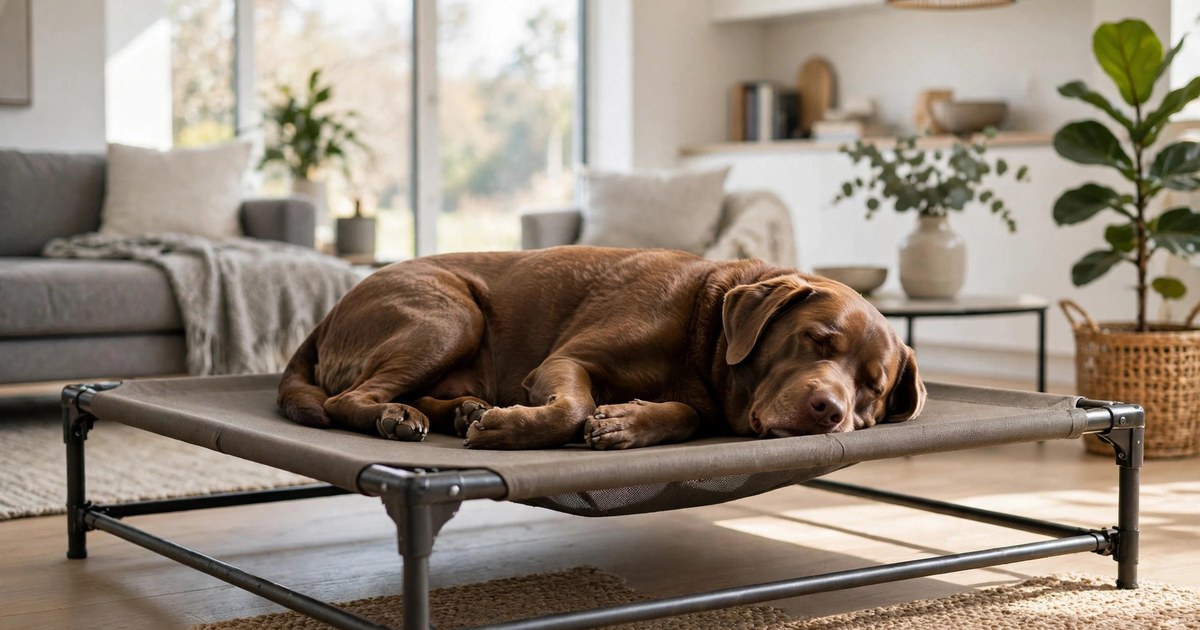
If your dog has shredded another bed, you have probably asked: are there any indestructible dog beds? Here is the honest answer: no dog bed is truly indestructible. A determined dog can damage almost anything made of fabric, foam, or stuffing. But you are not stuck buying a new bed every month. The best beds in this category are chew-resistant — built so a dog has almost nothing to grab, tear, or pull apart — and the toughest designs survive dogs that have destroyed a dozen ordinary beds.
What "Indestructible" Really Means
Marketing uses two phrases as if they were the same thing. They are not. Chew-proof means there is nothing for a dog to chew on: no loose edge, no exposed seam, no stuffing, and no soft corner a dog can get its teeth around. A raised cot with fabric wrapped inside a metal frame comes closest — the dog can mouth the taut surface, but there is nothing to grip and tear.
Chew-resistant means the bed is built to slow a determined dog down: heavy ballistic fabric, reinforced seams, dense foam, and hidden zippers. It lasts far longer than a standard bed, but a persistent chewer with enough unsupervised time can eventually get through it. Most beds sold as "indestructible" are really chew-resistant — a useful category, as long as you buy with your eyes open. The beds that come closest share one design idea: remove the grab points. Chewing starts at an edge, a corner, a seam, or a loose flap.
The 4 Bed Types That Survive Chewers
1. Elevated cot beds (best overall for chewers)
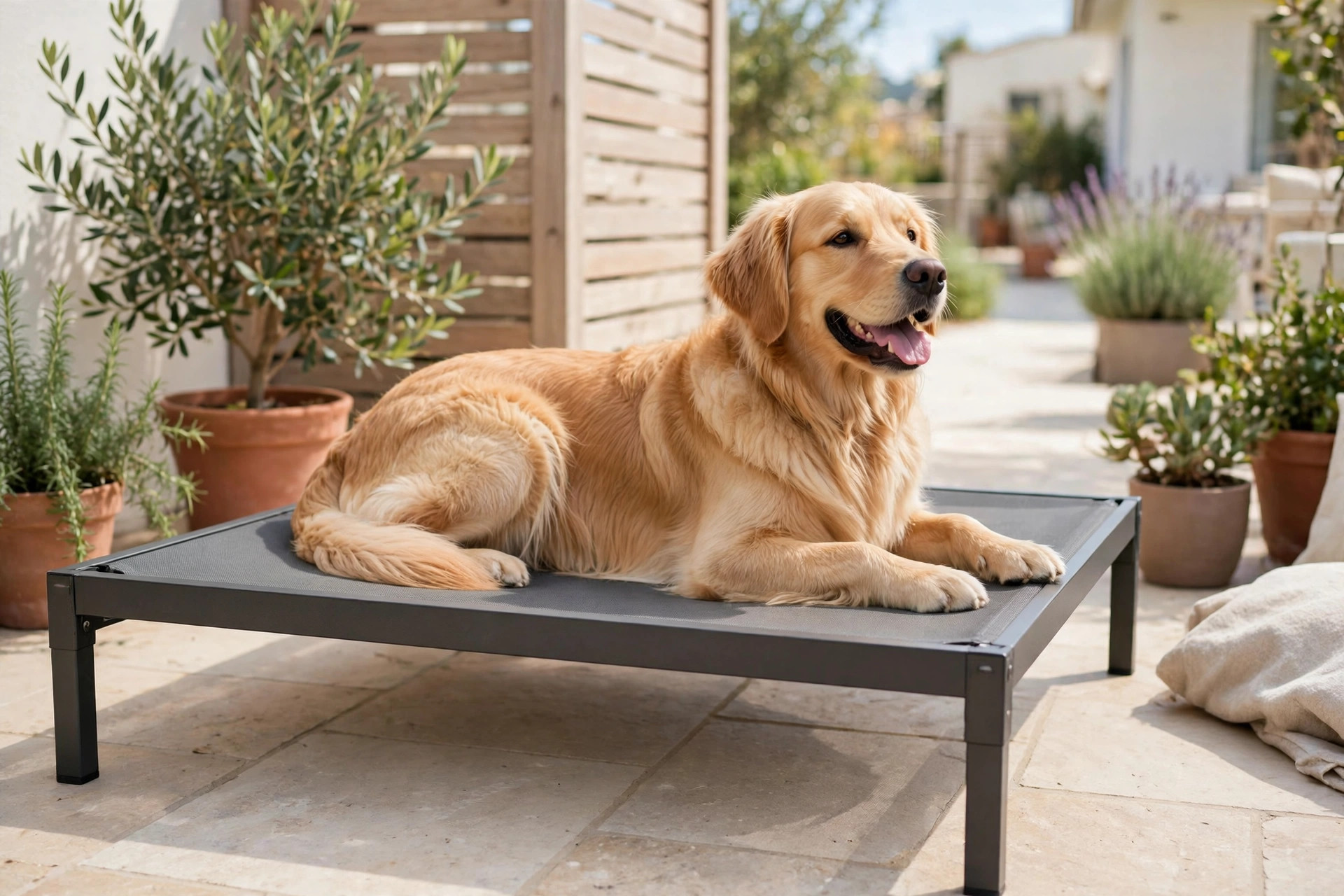
A cot is a frame — metal or PVC — with a taut fabric slung across it, raised a few inches off the floor. There is no stuffing to pull out, no soft edge to grab, and the fabric edges are wrapped inside the frame channel. This design survives the most dogs, including heavy diggers. The trade-off is a firmer sleep surface.
2. Armored crate pads (best for crate chewers)
Flat, stuffing-free pads built for crates, often with a metal frame that armors every edge. They solve the classic crate-owner complaint: a dog that shreds a pillow bed inside a closed crate. They are thin, so they suit dogs that sleep curled up, and they hose down easily.
3. Ballistic pillow beds (best for dogs that want softness)
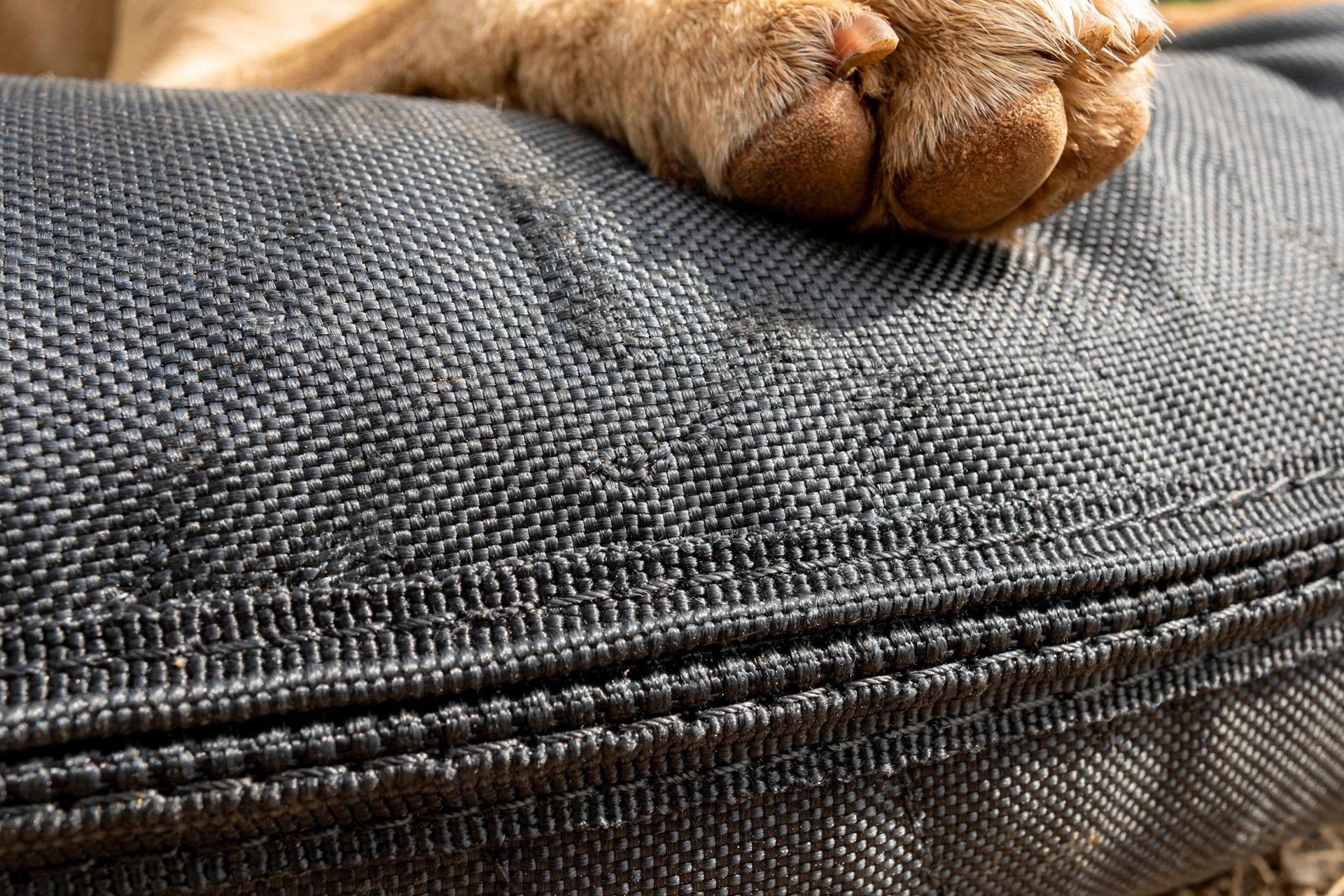
A pillow bed made from heavy ripstop or ballistic nylon — 1200 denier or above — with triple-stitched seams and a hidden zipper can survive light to moderate chewers while still feeling like a real bed. The weak point is always the seam or zipper, so check that both are buried under a flap.
4. Heavy canvas bolster beds (best for leaners, worst for chewers)
Bolster beds have raised sides dogs love to lean on — but those raised sides are also the first thing a chewer attacks. A heavy canvas bolster bed survives diggers well, yet it is the weakest of the four for a dog that chews deliberately. Buy one only if your dog destroys beds by digging, not by chewing.
| Bed type | Best for | Weak point | Typical price range |
|---|---|---|---|
| Elevated cot | Heavy chewers and diggers | Firmer sleep surface | $80–$150 |
| Armored crate pad | Crate chewers | Thin, less cushioning | $70–$130 |
| Ballistic pillow bed | Light to moderate chewers | Seams and zippers | $60–$120 |
| Heavy canvas bolster | Diggers and leaners | Raised sides get chewed first | $50–$110 |
What to Check Before You Buy: The 7-Point Checklist
- Fabric weight. Look for 1200D ballistic nylon, ripstop weave, or heavy canvas. Thin polyester or plush covers fail first.
- Hidden seams and zippers. Seams should be triple-stitched and tucked away; the zipper should sit under a fabric flap, not exposed on a corner.
- No loose edges. Anything a dog can pinch between its teeth — a flap, a tag, a piping cord — is where destruction starts.
- Frame or stuffing design. For cots, the frame should be metal or heavy PVC with the fabric wrapped inside the channel. For pillow beds, the foam should be dense and the cover removable.
- Weight rating. Rated capacity should be at least 20–30% above your dog's weight, so the fabric stays taut and the frame does not flex.
- Washable cover. A bed that cannot be washed will smell long before it wears out. Removable, machine-washable covers are worth paying for.
- Chewing warranty, read properly. Many "chew warranties" replace the cover once, for 90–180 days, and exclude foam and frame. A 1-year chew warranty on the whole bed is genuinely good.
The Real Cost: Is a Tough Bed Worth the Money?
This is the budget question behind the search, and the math is kinder than most owners expect. A standard $35 pillow bed lasts a heavy chewer about 6–8 weeks — roughly 6 beds a year, or about $210 a year, plus the mess. A $95 elevated cot that lasts 3 years costs about $32 a year. Even if you replace the fabric sling once at $30, the three-year total is around $125 — still far less than one year of cheap beds.
| Option | Upfront cost | How long it lasts | Cost per year |
|---|---|---|---|
| Cheap pillow bed, replaced often | ~$35 | ~7 weeks | ~$210 |
| Mid-range ballistic pillow bed | ~$85 | ~12 months | ~$85 |
| Elevated cot bed | ~$95 | ~3 years | ~$32 |
| Armored crate pad | ~$100 | ~2–3 years | ~$35–$50 |
These numbers use typical ranges, not any one product's price. But the direction is clear: for a dog that destroys beds, the expensive bed is usually the cheap option. The exception is a puppy that is still growing or a dog whose chewing is a short phase — there, a mid-range bed you replace once is the sensible middle ground. Our guide to whether orthopedic dog beds are worth it uses the same cost-per-year method.
Why Dogs Destroy Beds (and How to Slow It Down)
A tougher bed treats the symptom. The habit itself usually has a cause, and fixing the cause is what makes any bed last. Boredom is the most common one: a dog left alone for hours with nothing to do will make its own entertainment, and a bed is right there. A walk, a puzzle feeder, or a chew toy before you leave does more for bed survival than any fabric.
Anxiety also drives chewing — dogs that chew beds when left alone are often unsettled rather than destructive. A consistent leaving routine and short absences built up gradually help more than scolding ever will.
Teething and age matter too: puppies chew because their mouths hurt, and adolescent dogs chew because they are testing everything. For puppies, a cot or a crate pad usually survives the phase better than a soft bed. A bed that is too small or too thin also gets attacked more — our dog bed sizing guide shows how to measure.
Two rules help every bed last longer: never leave a new bed unsupervised for the first week, and remove the bed the moment chewing starts.

4 Mistakes That Kill Even Tough Beds
- Buying the wrong size. Too small and a dog can grab the edge and pull; too big and it sags into folds to chew. Measure your dog lying flat, then add a few inches.
- Leaving tags and loose threads. Cut off tags and trim loose threads weekly. One loose thread is an invitation.
- Washing it wrong. Hot water and harsh detergent break down ballistic coatings. Follow the care label.
- Putting a soft bed in a crate. Crates concentrate chewing. Use an armored pad in the crate and keep the soft bed in the living room.
FAQs
Are there any truly indestructible dog beds?
No. A determined dog can damage any fabric, foam, or frame given enough time. The toughest options are chew-resistant designs, and raised cot beds with the fabric wrapped inside a metal frame come closest, because there is no edge or seam for a dog to grab.
What material is hardest for dogs to chew through?
Heavy ballistic nylon (1200D or above) and tight ripstop weaves hold up best. Dense foam also resists digging better than loose fiberfill, which pulls out in clumps.
Are elevated dog beds good for chewers?
Yes — elevated cot beds are the single best choice for most chewers. With no stuffing, no soft edges, and fabric edges hidden inside the frame, there is almost nothing to destroy. They are also easy to clean and keep dogs cooler in warm weather.
How long should an indestructible dog bed last?
A well-built chew-resistant bed should last 2–3 years for a heavy chewer and much longer for a light one. If a bed marketed as chew-proof fails within weeks, check the warranty.
Do chew-proof warranties actually pay out?
Sometimes. Kuranda covers chewing for 1 year, while K9 Ballistics and Gorilla replace the cover once within about 120–125 days. Read the terms before buying: many warranties cover the cover only, exclude the foam and frame, and require photos and the original order number.
What should I do if my dog keeps destroying every bed?
First, switch to a cot or armored crate pad so there is nothing to shred. Second, look at the cause — boredom, anxiety, teething, or a bed that does not fit — and fix that alongside the bed. Third, supervise the new bed for the first week and remove it calmly when chewing starts. If the chewing is sudden, intense, or paired with other behavior changes, ask your veterinarian about it. For general guidance, the AKC's guide to choosing the right dog bed is a solid starting point, and the ASPCA's general dog care guide covers routines that reduce boredom-driven chewing.
Conclusion
So, are there any indestructible dog beds? Honestly, no — but there are beds that survive dogs who have destroyed everything else, and for most owners that is what actually matters. Start with a raised cot or an armored crate pad if your dog is a serious chewer, or a heavy ballistic pillow bed if the chewing is light. Check the fabric weight, the hidden seams, the weight rating, and the real warranty terms — then run the cost-per-year math. A $95 bed that lasts three years beats six $35 beds that last seven weeks each.
And remember the other half of the fix: a tired, settled dog with something better to chew is the best bed protection money cannot buy. Once the bed question is sorted, see how old your dog really is in human years with our dog age calculator — and if a bigger dog is part of the plan, our guide to the best orthopedic dog beds for large dogs covers the comfort side. More background on canine health is available from the Cornell Riney Canine Health Center.