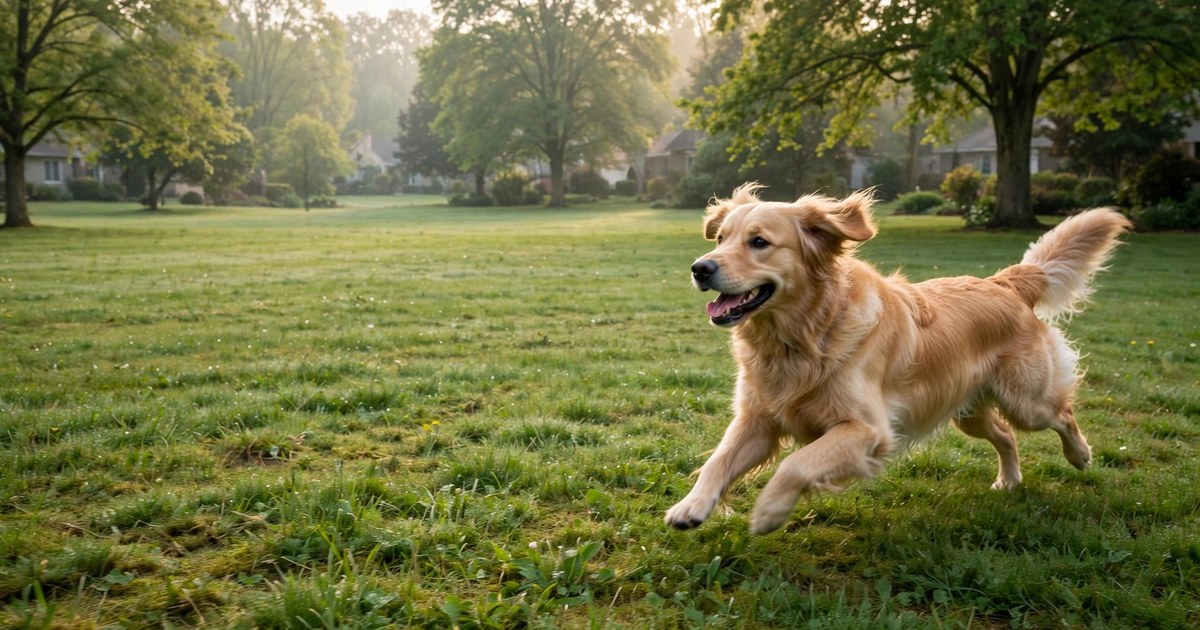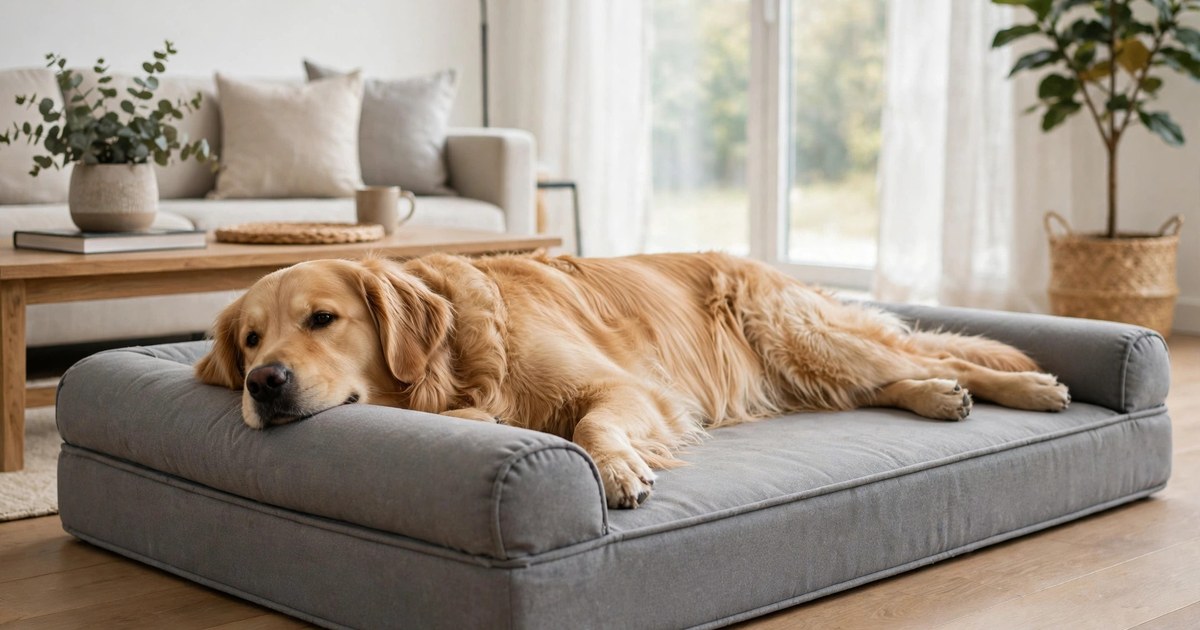
Most adult Golden Retrievers need a Large or XL bed with a sleep surface of 40 to 48 inches. That is the short answer. The longer answer matters more, because Golden Retrievers sit right on the line between bed sizes: a 55-pound female and a 75-pound male are both "a Golden Retriever," but they need different beds.
This guide gives you the exact size for your dog: measure in two minutes, read the size chart, and order the right label the first time.
Golden Retriever size at a glance
The breed standard explains why one label never fits every Golden. According to the American Kennel Club breed standard for Golden Retrievers, adult males stand 23 to 24 inches at the shoulder and weigh 65 to 75 pounds. Adult females stand 21½ to 22½ inches and weigh 55 to 65 pounds.
That 20-pound spread is the whole problem. A 55-pound female stretched out is roughly 36 inches nose to tail; a 75-pound male can be 42 inches or more. Add 8 to 12 inches of stretching room and the female lands on a 44-inch bed while the male needs 48 inches or longer. Same breed, different bed.
Weight charts disagree, too. Some online charts list Goldens at 70 to 100 pounds — wrong against the AKC standard, and enough to push you a full size too big. Trust your tape measure over any breed table.
How to measure your Golden in 2 minutes
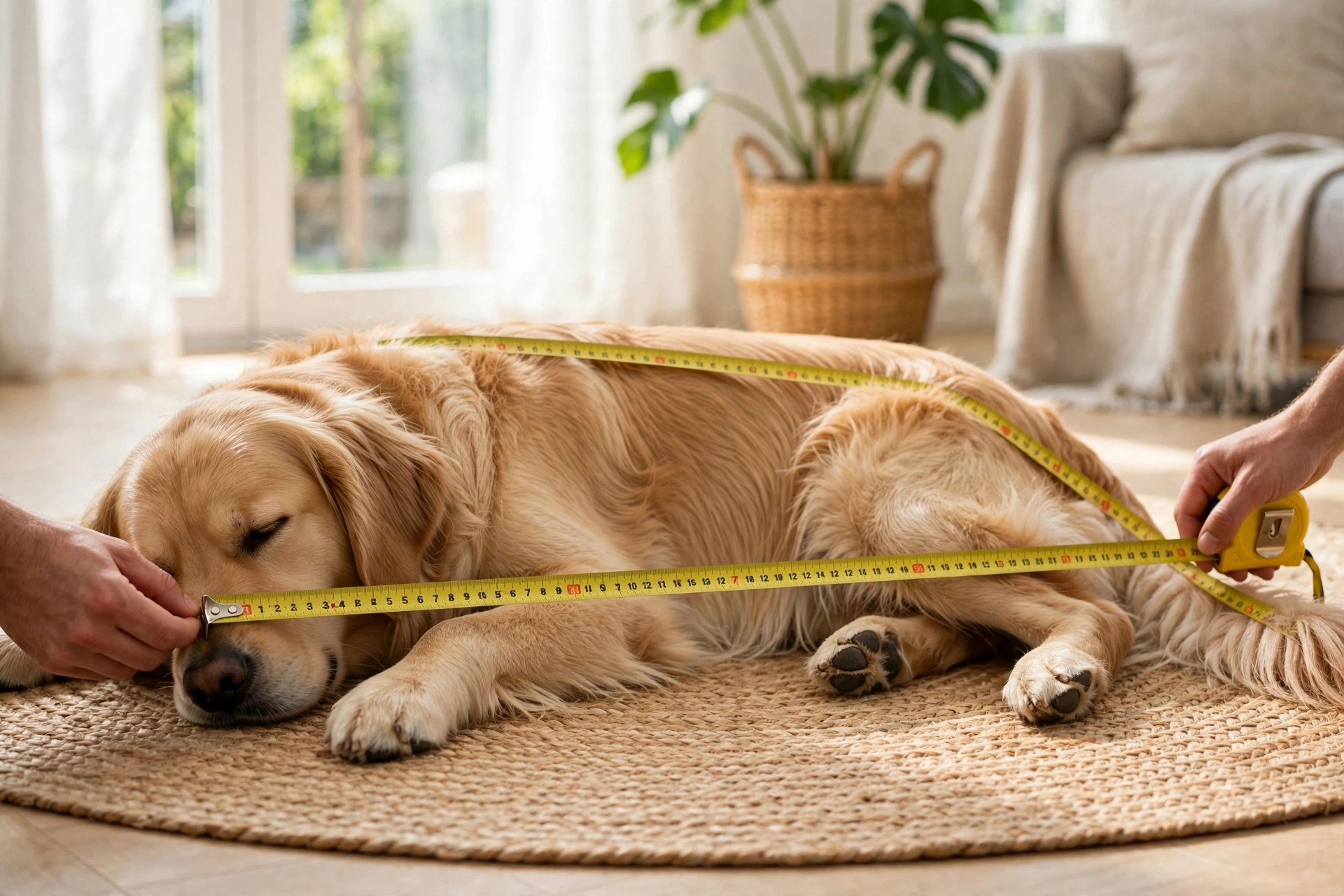
Do this while your dog is asleep or deeply relaxed — a standing dog measures shorter, and the sleeping length is the one that matters.
Step 1: Measure length. Lay the tape from the tip of the nose to the base of the tail — not the tip of the tail — while your dog lies stretched out on its side. Most adult Goldens measure 36 to 42 inches here.
Step 2: Add 8 to 12 inches. This is the stretching buffer. Add 8 inches for a dog that sleeps curled, 12 inches for a sprawler — a dog that cannot fully extend its legs will either hang off the edge or curl up tighter than it wants to.
Step 3: Measure width. Measure across the widest part of the chest or shoulders and add 6 to 8 inches. A Golden that sleeps on its back with its legs in the air needs that width more than a curled sleeper does.
Worked example: Your Golden measures 38 inches nose to tail and sleeps stretched out. 38 + 12 = 50 inches of sleep surface needed — an XL bed in most brands (typically 48 x 30 inches or larger). If the same dog slept curled, 38 + 8 = 46 inches, and a Large at 42 to 44 inches would be close, but the XL is still the safer buy.
One more check before you order: compare your number to the bed's sleep surface, not its outer dimensions. A bolster bed that measures 44 inches outside may offer only 36 inches of flat sleeping space once the raised edges are counted. Brands list outer dimensions more prominently, so look for the inner or "sleeping area" figure — if it is not listed, assume you lose 3 to 4 inches on each side to the bolsters.
What the size labels actually mean
Dog bed sizes are not regulated — one brand's Large is another's XL. Use this table as a rough map, then confirm the inches on the bed you buy.
| Label | Typical dimensions | Sleep surface (approx.) | Fits which Golden? |
|---|---|---|---|
| Medium | 30 x 21 in | ~28 in | Golden puppies only, up to ~4 months |
| Large | 36 x 27 in | ~34 in | Small adult females that sleep curled — rarely enough |
| Large | 42 x 30 in | ~40 in | Most adult females (55–65 lb) |
| XL | 48 x 30 in | ~46 in | Most adult males (65–75 lb) and sprawlers |
| XXL | 52 x 36 in | ~50 in | Very large males, or two Goldens sharing |
The pattern is clear: Large (42-inch) is the minimum for most adult Goldens, and XL (48-inch) is the right call for most males and any dog that sleeps stretched out. When your measurement falls between two sizes, size up — a bed a few inches too big still gets used, while a bed a few inches too small gets abandoned for the floor.
For the full method, see our guide on how to choose an orthopedic dog bed size.
Puppy, adult, and senior: size changes with age
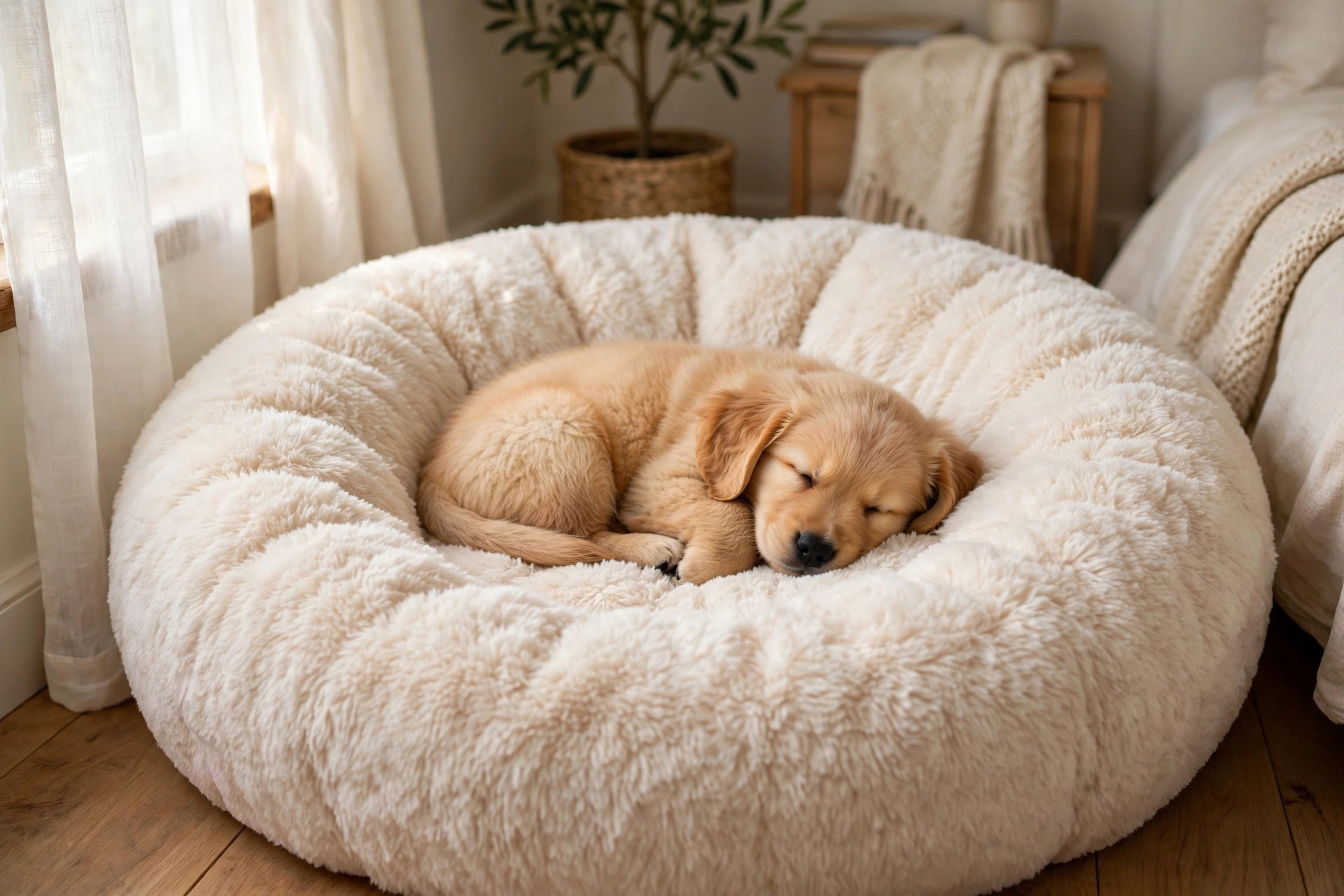
Golden puppies grow fast and outgrow beds faster. A 3-month-old puppy fits a Medium bed, but will need a Large within a few months and an XL by 12 to 18 months. Buying the adult size early wastes nothing — a puppy in a big bed is fine. The exception is a chewer: buy a cheap interim bed and save the good one for adulthood, because Golden puppies are famous for destroying beds.
Adult Goldens (1 to 7 years) are the straightforward case: measure once, buy Large or XL, and invest in quality foam — the bed gets daily use for the longest stretch of the dog's life.
Senior Goldens (8 years and up) need the same length but thicker foam — 6 to 7 inches of solid foam instead of 4. Older dogs spend more hours on the bed and get up and down more slowly, so a low, thin bed that is easy to step onto and does not bottom out matters more than it did at age three. A bed with a low entry edge helps: high bolsters a young dog hops over become a hurdle for a stiff senior.
Crate bed vs. floor bed: different sizes
If the bed is going inside a crate, the crate decides the size, not the dog. The standard adult Golden crate is 42 inches long, and the bed inside it must be 42 x 28 inches or smaller to fit flat. A 48-inch XL bed will bunch up in a 42-inch crate — buy the crate pad separately from the floor bed.
For a floor bed, the measuring method above is the whole story. One practical tip: put the bed where your Golden already sleeps. A perfectly sized bed in the wrong room gets ignored.
5 signs the bed is the wrong size
- Paws or head hang off the edge. The clearest sign. If any part of your dog regularly dangles off the bed, the sleep surface is too short.
- Your Golden sleeps next to the bed, not on it. Dogs vote with their bodies. A dog that curls up on the bare floor beside an expensive bed is telling you the bed is too small, too hot, or both.
- They only sleep curled, never stretched. Some dogs are natural curlers. But a dog that used to sprawl and now only curls may have learned the bed is too short to stretch on.
- The bed slides or tips when they climb on. An undersized bed cannot take a 70-pound dog's weight, especially a bolster bed with a narrow base.
Beyond size: what else matters for a Golden
Size is the first decision, not the only one. Three features matter most for Goldens:
Foam thickness. At least 4 inches of solid foam for an adult Golden; 6 to 7 inches for seniors or dogs over 60 pounds. Thin egg-crate foam compresses under a 70-pound dog within months, and once it flattens, the bed is a mat. Our roundup of the best orthopedic dog beds for large dogs compares foam thickness across the beds that hold up under big dogs.
Washable cover. Goldens shed year-round and swim whenever they get the chance. A removable, machine-washable cover is not a luxury for this breed — it is the difference between a bed that lasts two years and one that smells after two months. Check that the cover zips off fully; some "washable" beds only spot-clean.
Waterproof liner. Between muddy paws, wet fur, and the occasional accident, a waterproof liner protects the foam itself. Foam that gets wet and stays wet loses its shape and starts to smell. A liner costs little and saves the bed.

If you are weighing whether the extra cost of a proper orthopedic bed is worth it, our breakdown of whether orthopedic dog beds are worth it runs the cost-per-year math. The AKC's guide to choosing the right dog bed covers the same ground from the breed-club side, and the ASPCA's general dog care guide is a solid starting point for first-time Golden owners.
Frequently asked questions
What size dog bed does a Golden Retriever need?
Most adult Golden Retrievers need a Large or XL bed — a sleep surface of 40 to 48 inches. Measure your dog nose to tail while lying down, add 8 to 12 inches, and buy the bed whose sleep surface matches that number. Most females land on a 42-inch Large; most males need a 48-inch XL.
Is a Large bed big enough for a Golden Retriever?
Sometimes. A 42-inch Large works for smaller adult females (55 to 60 pounds) that sleep curled, but it is usually too small for males over 65 pounds and for any Golden that sleeps stretched out. If nose-to-tail plus 8 inches is over 44 inches, go XL.
What size crate bed fits a Golden Retriever?
A 42-inch crate is the standard adult Golden size, and the bed inside it should be 42 x 28 inches or smaller. Measure your crate's interior before ordering — a bed even an inch too long will bunch up.
Should I buy a bed for my Golden puppy's adult size?
You can, and it saves buying twice. A puppy in an adult-size bed is perfectly fine. The exception is a heavy chewer: buy a cheap interim bed first, then the good adult bed once the chewing phase passes, usually around 12 to 18 months.
How thick should a Golden Retriever's bed be?
At least 4 inches of solid foam for a healthy adult, and 6 to 7 inches for seniors or dogs over 60 pounds. Foam thinner than 4 inches will compress under a Golden's weight and stop supporting the dog within months.
The bottom line
Measure your Golden lying down, add 8 to 12 inches, and buy the bed whose sleep surface — not its outer size — matches that number. For most adult Goldens that means a 42-inch Large at minimum and a 48-inch XL for most males and sprawlers. Size up when you are between sizes, and check the inner dimensions on bolster beds. Before you buy, try our dog age calculator to see where your Golden is in life — then match the foam to the stage: 4 inches for adults, 6 to 7 inches for seniors.