If you live with both a dog and a cat, you already know the scene: you set the cat's bowl down, turn your back for ten seconds, and your dog has vacuumed up every last kibble. Learning how to keep dog out of cat food is one of the most common multi-pet household struggles — and it matters. An occasional stolen bite is unlikely to hurt your dog, but a regular habit can cause stomach upset, weight gain, and even pancreatitis, because cat food is far richer in protein and fat than dog food (the AKC explains why cat food isn't a substitute for dog food).
The good news: this problem is completely solvable. Below are seven proven fixes that actually work — from five-minute setup changes to a simple training plan — plus two "shortcuts" to skip.
Why Your Dog Is Obsessed With Your Cat's Food
It helps to know what you're up against. Cats are obligate carnivores, so their food is packed with meat-based protein — it smells stronger and tastes richer than most dog food. Dogs are natural scavengers, so a warm, meaty-smelling bowl at nose level is basically irresistible. Your dog isn't being "bad"; it's being a dog. Still, a daily cat-food habit can lead to digestive upset, obesity, and pancreatitis — so fixing this is a health-smart move, not just a tidiness one.
The 7 Fixes That Actually Work
1. Stop Free-Feeding: Switch to Scheduled Mealtimes
The single biggest mistake in multi-pet homes is leaving the cat's bowl out all day. A bowl that's always full is always a temptation — and it makes every other fix ten times harder. Most healthy adult cats adjust to scheduled meals within a week.
How to make the switch:
- Feed twice a day, 10–12 hours apart (for example, 7 AM and 6 PM). Keep it consistent — cats learn routines fast.
- Put the bowl down for 20–30 minutes, then pick it up — finished or not. Your cat will quickly learn mealtime has a window.
- During the transition week, supervise mealtimes or keep the dog in another room for those 30 minutes.
A bonus: you actually notice how much your cat eats each day. VCA Hospitals notes that most adult pets thrive on a regular feeding schedule rather than grazing all day.
2. Feed Your Cat Up High
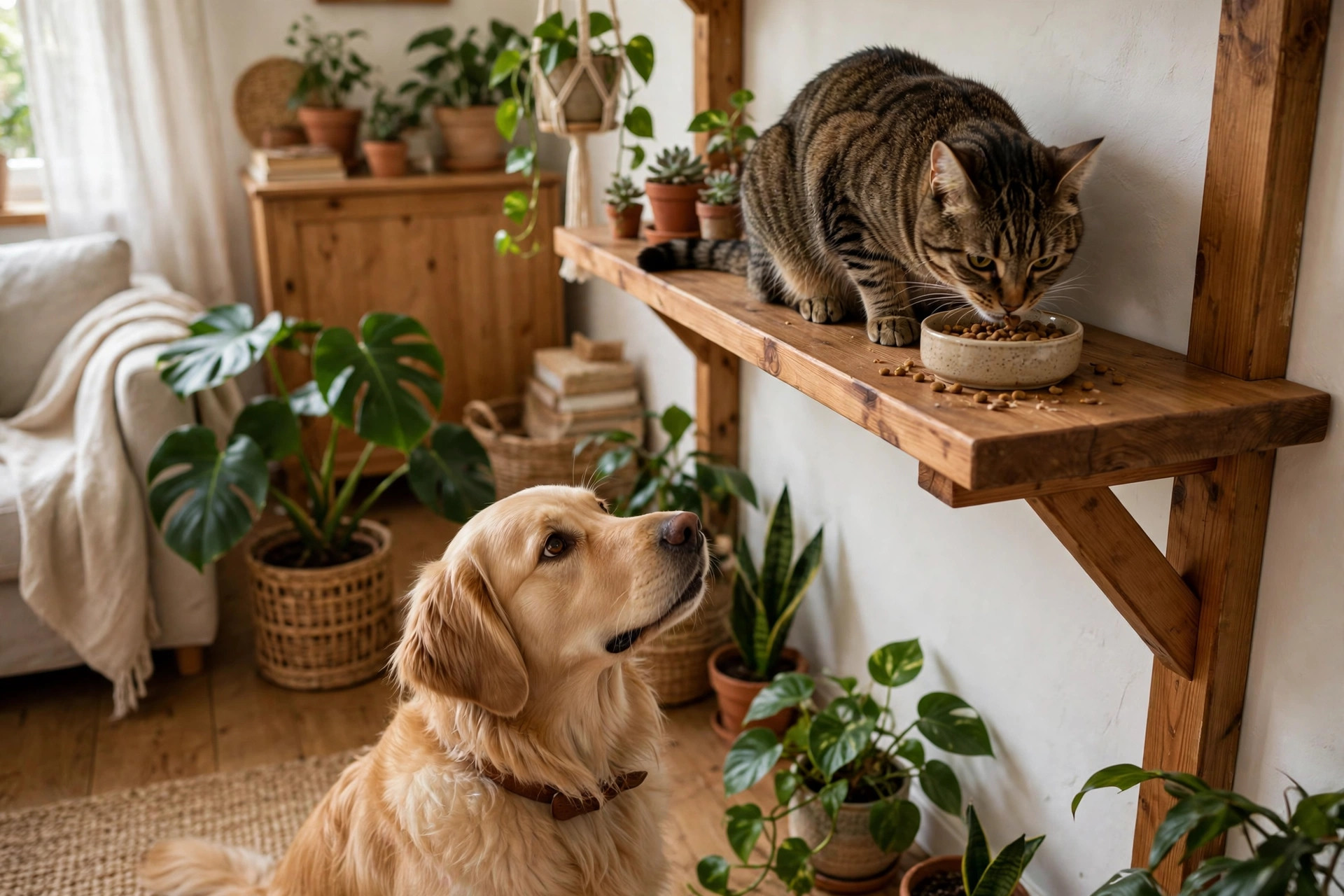
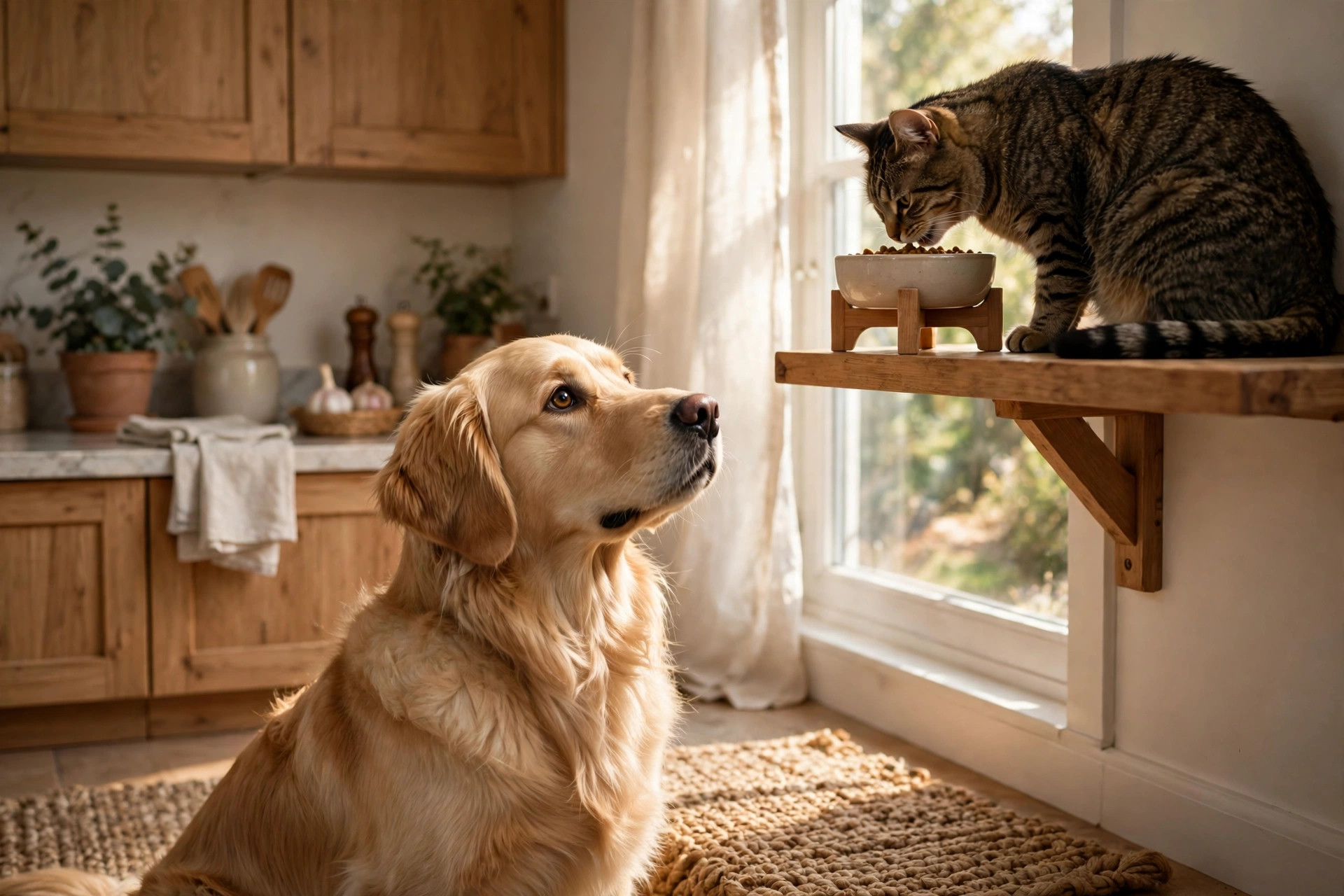
Cats climb; most dogs don't. Moving the cat's food to an elevated spot is the fastest physical fix there is — it works the same afternoon you do it. Good spots: a sturdy wall-mounted shelf, a wide window ledge, a corner of the kitchen counter (with a washable mat), or a cat tree platform with a tray.
Keep it safe and cat-friendly: make sure the surface is stable and non-slip, leave a clear jump path (a chair, cat tree, or step below), and keep the bowl away from the edge. Adjust for your animals: senior or arthritic cats need a modest height, while large counter-surfing dogs need more height or a different fix from this list.
3. Install a Baby Gate or Door Strap
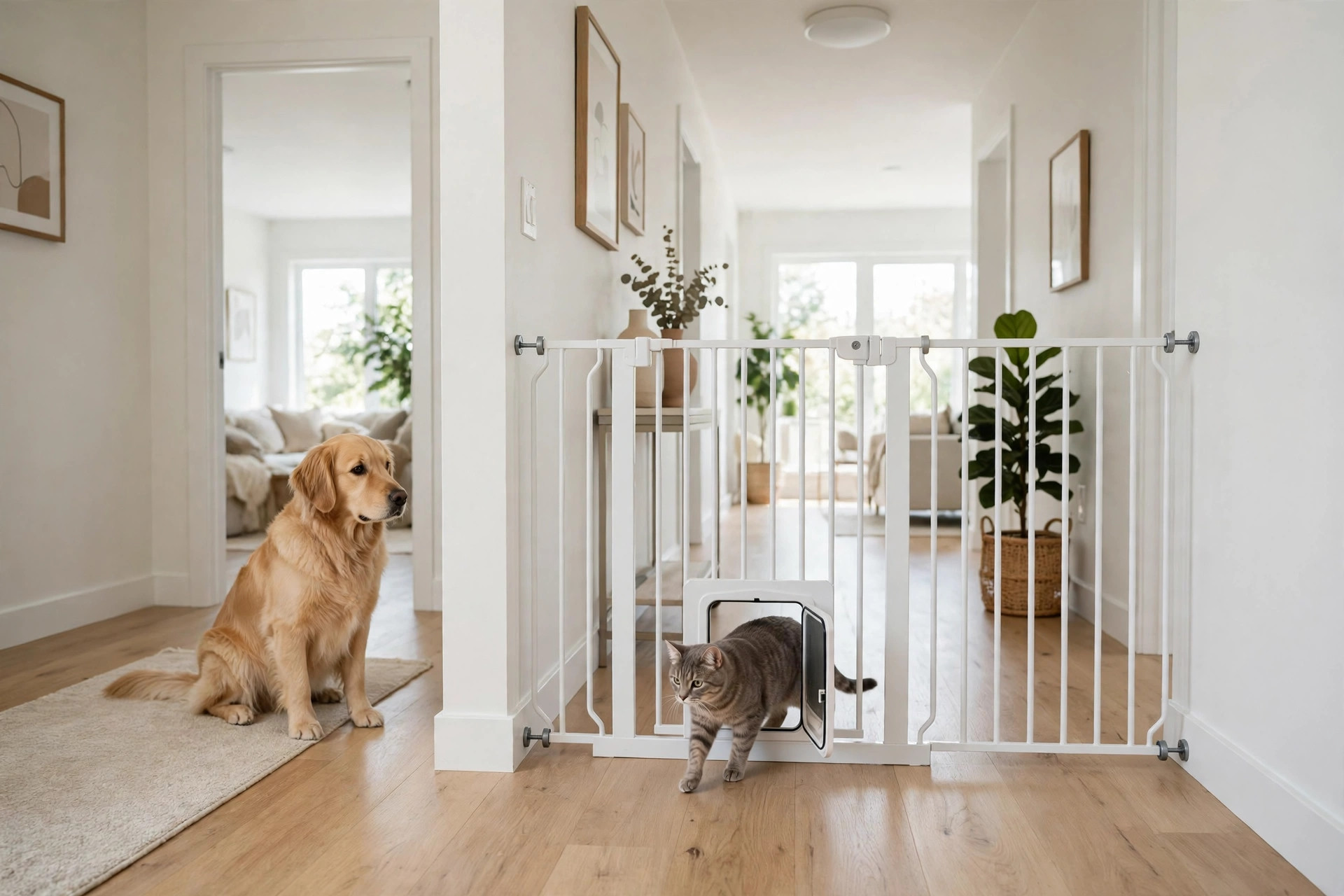
A baby gate with a small built-in pet door is the classic multi-pet solution, and it still works brilliantly: the cat slips through the little door, the dog can't follow. With a standard gate, you can also mount it a few inches off the floor so the cat ducks under — though that trick fails with puppies, which fit under too.
The door-strap trick: an inexpensive door strap holds an interior door open just 5–6 inches — wide enough for a cat, too narrow for most dogs. It needs no drilling, costs very little, and works on any standard door. Pair it with scheduled mealtimes so the cat's food is only "exposed" during a short window.
4. Create a Cat-Only Feeding Room
Dedicate one small room — a laundry room or a spare closet — as the cat's feeding zone, with access controlled by a cat flap. Use a microchip cat flap: it reads your cat's microchip (or RFID collar tag) and only unlocks for that cat, which solves the small-dog problem completely. Set it up with the bowl on a washable mat and water a few feet away. Our pet-friendly apartment checklist covers room-by-room setup ideas for multi-pet spaces.
5. Train "Leave It" — Step by Step

Management tools (gates, shelves, feeders) stop the stealing today; training stops it long-term. "Leave it" is the single most useful cue for a dog in a multi-pet home, and you can build it in about two weeks of short daily sessions:
Days 1–2: The closed fist. Hold a treat in your closed fist. The instant your dog pulls away or looks at you, say "yes" and give a better treat from your other hand. Five minutes a day.
Days 3–4: The open hand. Hold the treat in your open palm. Say "leave it." If the dog lunges, close your fist; if it waits or looks at you, reward from the other hand.
Days 5–7: Treat on the floor. Place a treat on the floor under your hand. Say "leave it" and reward backing off — always with the better treat from your hand, never the floor treat.
Days 8–14: The real thing. With your dog on a leash, walk past the cat's bowl at a distance. Say "leave it" before the dog fixates, reward generously for disengaging, and gradually decrease the distance over sessions.
Three rules that make or break it: keep sessions under 10 minutes, never punish a failed rep (just reset and make it easier), and practice with every family member so the cue means the same thing from everyone.
6. Feed Both Pets at the Same Time
A dog that just ate a full meal is dramatically less interested in the cat's bowl. Synchronizing mealtimes removes the "I'm hungry and that smells amazing" window entirely: feed the dog first (or at the exact same moment) in the kitchen, the cat at its elevated spot or feeding room, and pick the cat's bowl up after 30 minutes. This works best combined with Fix #1's scheduled mealtimes — together, they're the backbone of a steal-proof routine.
7. Try a Microchip-Activated Cat Feeder
Selective feeders are the tech solution: the lid only opens for your cat's registered microchip or RFID collar tag and seals shut when the cat walks away. The food inside is never available to the dog — even if the bowl sits on the floor in the open.
They're especially useful when your dog is small enough to follow the cat through doors and gates, your cat is a grazer that won't adapt to scheduled meals, or you work long hours. Look for a sealed lid and a collar-tag option if your cat isn't microchipped. If you're shopping for feeding gear anyway, our guide to the best automatic feeders for two-cat homes covers what to look for in 2026 models.
Two "Fixes" You Should Skip
Spray bottles and punishment. Some older guides suggest spraying the dog or shaking a can of coins when it approaches the cat's bowl. This is outdated advice: it damages trust, teaches the dog to steal food only when you're not watching, and can make some dogs gulp faster — the opposite of what you want. Positive training (Fix #5) is slower, but it actually lasts.
Randomly moving the bowl around. Hiding the cat's food in a new spot every day confuses the cat more than it deters the dog. Cats are routine animals — pick one good spot (high, gated, or in a cat-only room) and keep it there.
Quick-Start Checklist: Your First 48 Hours
Want this fixed by the weekend? Work through this checklist in order:
- ☐ Switch the cat to two scheduled meals; pick the bowl up after 30 minutes.
- ☐ Move the cat's bowl to an elevated spot or behind a baby gate — today.
- ☐ Feed the dog at the same time as the cat, in a separate spot.
- ☐ Start "leave it" training: Day 1 closed-fist session, 5 minutes.
- ☐ If the dog is small or persistent, order a door strap or a microchip feeder.
- ☐ Tell every family member the new routine — consistency is the whole game.
Frequently Asked Questions
Is it OK if my dog eats cat food once in a while?
A single stolen mouthful is unlikely to cause harm — the AKC notes an occasional nibble probably won't hurt your dog. The problem is regularity: daily cat food throws off a dog's nutrient balance and can lead to digestive upset, obesity, and pancreatitis over time.
Why does my dog prefer cat food over his own food?
Cat food is higher in meat-based protein and fat, so it smells and tastes stronger than most dog food. Dogs are scavengers by nature, so the richest-smelling option always wins. It says nothing about the quality of your dog's own food.
Will feeding my cat on the counter teach the cat to counter-surf everywhere?
Not if you designate one specific, consistent spot. Cats learn "this corner is mine" quickly. Use a washable mat to mark the feeding zone and keep the rest of the counters food-free.
Do microchip feeders work if my cat isn't microchipped?
Yes — most selective feeders also work with a lightweight RFID tag on the cat's collar. Use a breakaway safety collar, and check the tag's battery or registration per the manufacturer's instructions.
My puppy is small enough to fit through the cat door. What now?
Skip the standard cat flap and go straight to a microchip-activated flap or feeder, which only opens for the cat. A door strap holding the door at 5 inches also works — the cat slips through while the puppy's body usually can't.
How long does "leave it" training take?
Most dogs learn the basics in 1–2 weeks of daily 5-minute sessions and can apply it around the cat's bowl within 3–4 weeks. Keep using management (gates, schedules) while training builds — the two work best together.
The Bottom Line
Keeping your dog out of the cat food comes down to a simple formula: scheduled meals + a dog-proof feeding spot + basic "leave it" training. Start with the quick wins — an elevated bowl and synchronized mealtimes work from day one — then layer in training and, if needed, a microchip feeder for a permanent fix.
Feeding routines also change as your dog ages, so it's worth knowing where your dog is in its life stages — try our Dog Age Calculator to see your dog's real age in human years. And if your indoor cat needs more to do between meals, our guide on how to keep an indoor cat entertained has plenty of ideas.