Feeding Two Cats Is Harder Than It Looks
If you share your home with two cats (or a cat and a dog), you already know the mealtime drama: one pet eats too fast, the other gets pushed off the bowl, and whoever wakes up earliest stages a 5 a.m. hunger protest. Automatic feeders solve the timing part beautifully — but most roundups review them as if every home has exactly one pet.
This guide is different. Every feeder below was chosen for how well it works in a multi-pet home: two cats on the same schedule, a cat-and-dog pair, or a house where you travel and need meals handled reliably for more than one animal. You'll get honest comparisons, who each pick is (and isn't) for, and the real trade-offs — so you buy once, not twice.
Affiliate disclosure: This post contains affiliate links. If you buy through them, CalcPet may earn a commission at no extra cost to you. Rankings are based on product specs and verified buyer feedback — never on commission rates.
Top 4 picks at a glance:
- Best for Two Cats: WOPET Automatic Cat Feeder for Two Cats — purpose-built dual bowls, no second feeder needed
- Best Smart Pick: PETLIBRO Granary WiFi Feeder (5L) — app scheduling with up to 10 meals a day
- Best for Large Households: PetSafe Smart Feed Automatic Pet Feeder (6L) — big 6L hopper for heavy appetites
- Best for Feeding Records: PETKIT Automatic WiFi Pet Feeder — detailed feeding history in the app
What Actually Matters in a Multi-Pet Feeder
Before the picks, here's the short checklist buyers of multi-pet homes use to narrow the field. Keep these in mind and the right choice gets obvious fast.
1. Dual bowls vs. two separate feeders
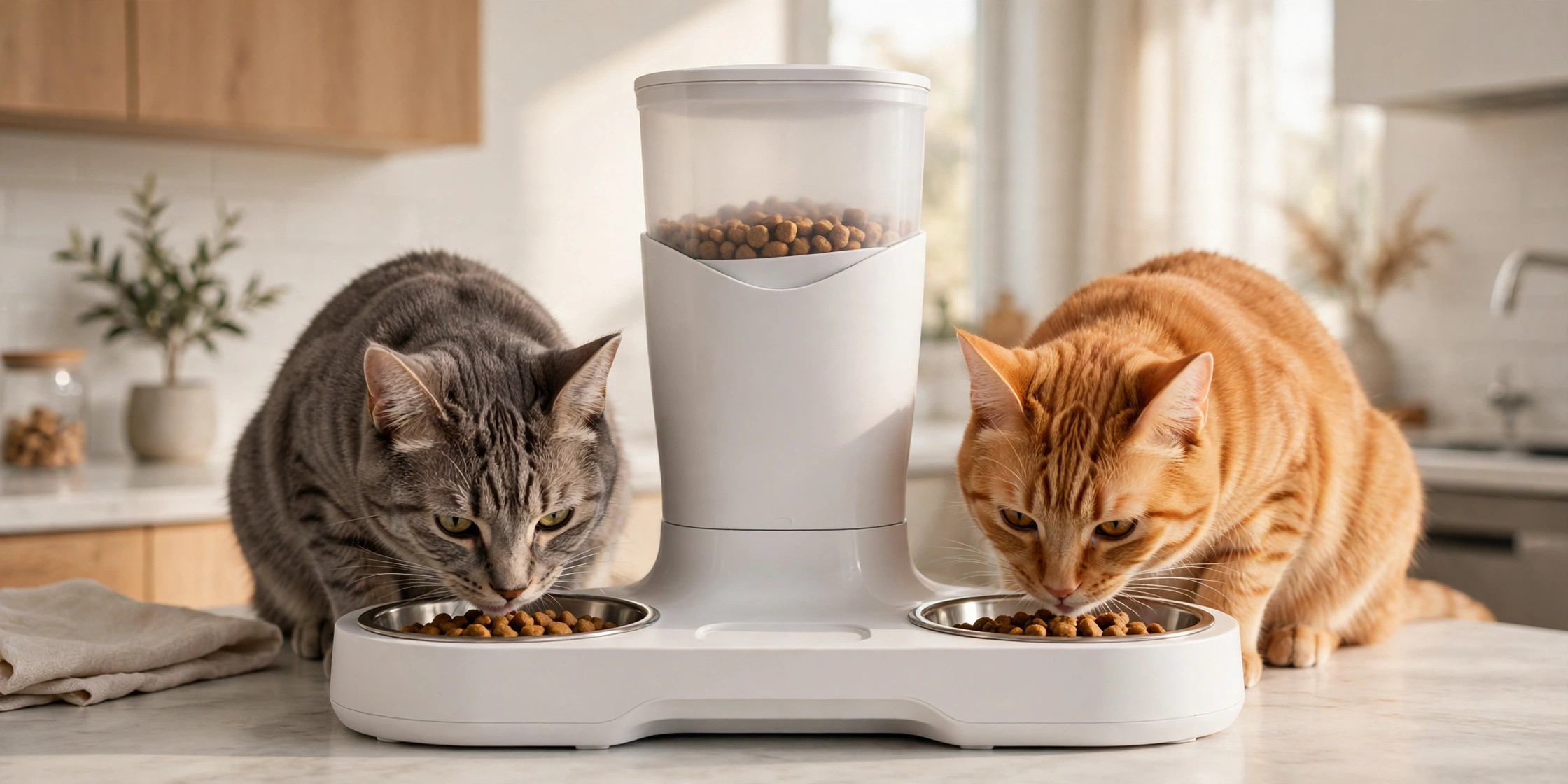
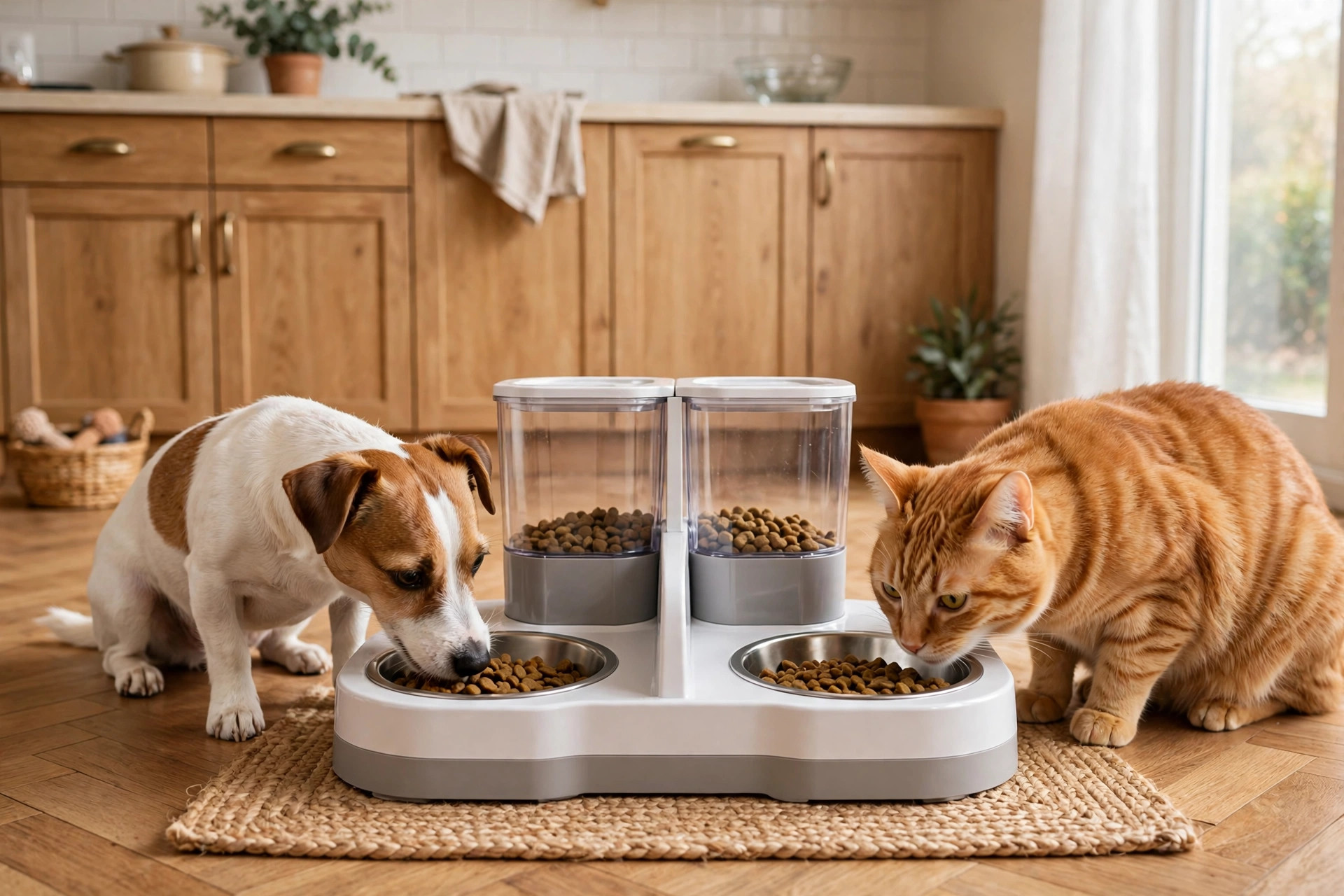
A dual-bowl feeder like the WOPET drops food into two bowls from one unit — simple, affordable, and both pets eat at the same time. The trade-off: portions are split evenly, so it works best when both pets can eat the same food in similar amounts. If your pets need very different portions or different food, two separate programmable feeders (or microchip-selective feeders, a separate category) is the honest answer.
2. Hopper capacity math
Two mouths empty a hopper twice as fast — that part is just arithmetic. A 5–6L hopper keeps a pair of cats going for many days between refills, which is exactly what you want before a weekend away. Smaller hoppers mean more frequent refilling, which defeats the purpose.
3. Portion accuracy and meal count
More scheduled meals per day with small portions keeps fast eaters from gorging and slower eaters from missing out. Feeders offering 6–12 meals a day give you far more control than a 2–4 meal timer. Slow-feed modes (like the PetSafe Smart Feed's 15-minute dispensing) help with speed-eaters too.
4. Bowl spacing and access
The classic multi-cat complaint is one cat body-blocking the other. Bowls set wide apart — or two physically separate bowls — let both pets eat without crowding. Watch for this in the design, not just the marketing.
5. Power backup
With two pets depending on one feeder, a dead battery during a power outage is a bigger problem than in a single-pet home. Dual power (wall adapter + battery backup) is worth prioritizing — and one of the feeders below has it standard.
If you also feed wet food, read our guide on kibble vs wet food scheduling with automatic feeders first — these four picks are all designed for dry kibble.
The 4 Best Automatic Feeders for Two Cats and Multi-Pet Homes
WOPET Automatic Cat Feeder for Two Cats
- Dual stainless steel bowls feed two cats simultaneously
- Programmable timer — up to 6 meals per day
- 10-second voice recording plays a meal call
As an Amazon Associate, CalcPet earns from qualifying purchases.
The WOPET is the only pick here designed from the ground up for two cats, which is why it tops this list. One hopper splits meals into two stainless steel bowls at the same time, so both cats eat together without you buying — and syncing — a second feeder. Setup is refreshingly old-school: a simple LCD panel, no app, no account, no Wi-Fi needed. The 10-second voice recording is a nice touch — record your own meal call and both cats learn the routine fast.
Best for: Two-cat households that want the simplest reliable setup. Not ideal for: homes where the two cats need different foods or very different portions — split bowls mean equal shares, so diet-separated households should look at microchip feeders instead. Pros: Purpose-built for two-cat homes — no second feeder needed; dual power: adapter plus battery backup for outages; simple LCD setup — no app or account required. Cons: Newer listing with a smaller review base; dry food only (2–12mm kibble); larger footprint than single-bowl feeders.
PETLIBRO Granary Automatic Pet Feeder (WiFi, 5L)
- 5L hopper with 5G/2.4G Wi-Fi app control — up to 10 meals per day
- Freshness preservation with desiccant bag plus low-food sensor alerts
- Twist-lock lid keeps clever paws out of the food hopper
As an Amazon Associate, CalcPet earns from qualifying purchases.
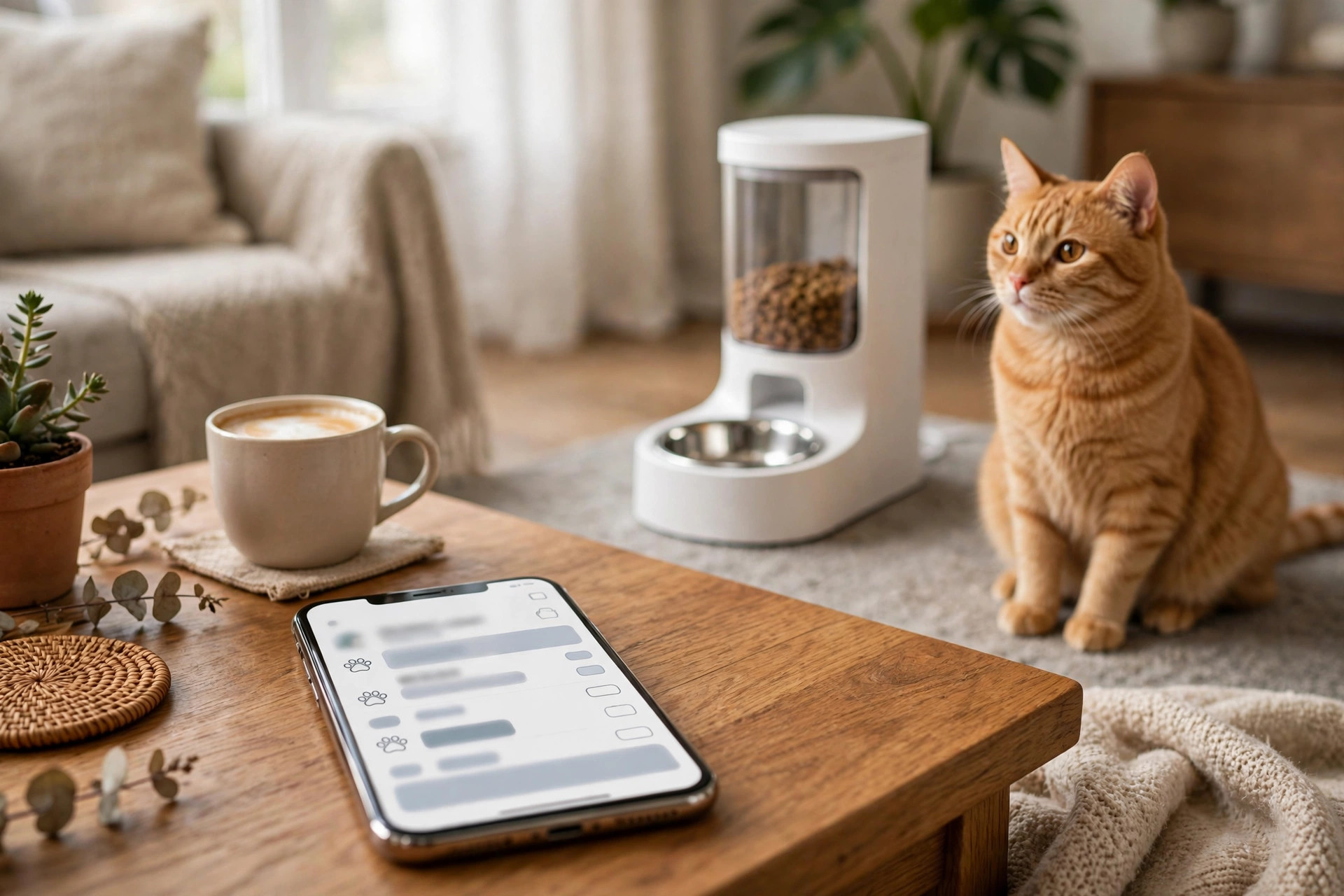
Let's be straight: the Granary is a single-tray feeder, not a dual-bowl unit. So why is it #2 on a multi-pet list? Because it's the strongest smart feeder in this price range, with a review base (~10,000 ratings) none of its rivals touch — and multi-pet homes that feed two of the same Granary (one per pet, synced in the app) get per-pet schedules, per-pet portion sizes, and feeding logs for each animal. If your pets need different portions or different mealtimes, two Granaries genuinely beats one dual-bowl feeder. The twist-lock lid is also a real asset in homes with a food-obsessed cat or a determined dog.
Best for: App-controlled scheduled feeding for cats and small dogs; owners who want per-pet control with two synced units. Not ideal for: anyone wanting two-bowl feeding from a single unit — that's the WOPET's job. Pros: Huge review base (~10,000 ratings) for a feeder in this range; flexible app scheduling suits shift workers and travelers; made for both cats and small-to-medium dogs; 24-month warranty. Cons: Wi-Fi setup can be fiddly on 5G-only networks; replacement desiccant bags are an ongoing cost; dry kibble only — no wet food support.
PetSafe Smart Feed Automatic Pet Feeder (6L)
- Large 6L (24-cup) hopper — fewer refills per week
- Schedules up to 12 meals/day, 1/8 to 4 cups per meal
- Slow-feed mode dispenses over 15 minutes; works with Alexa
As an Amazon Associate, CalcPet earns from qualifying purchases.
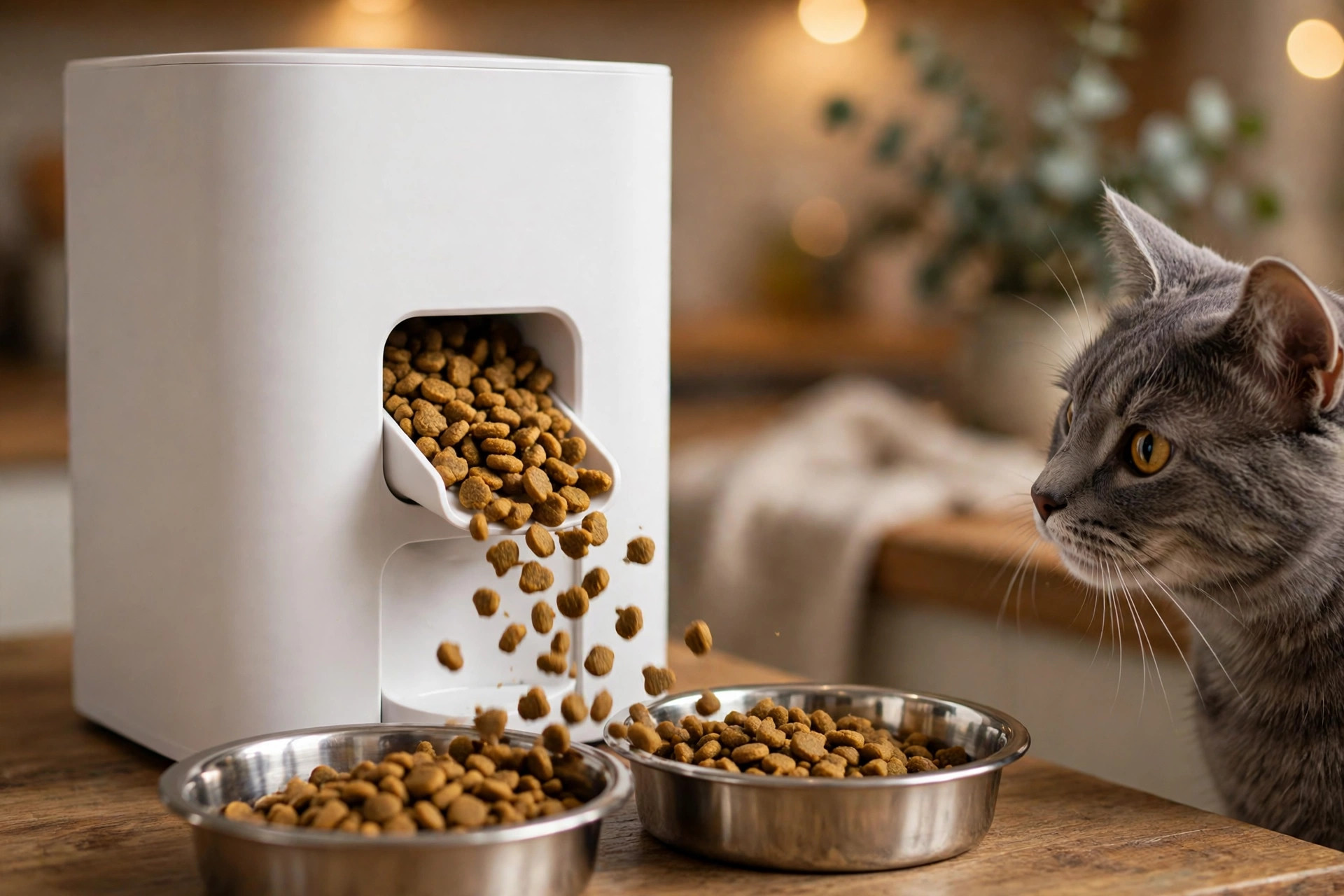
The PetSafe Smart Feed earns its spot with sheer capacity: a 6L hopper — the biggest on this list — plus up to 12 scheduled meals a day and portion sizes from 1/8 to 4 cups per meal. That range is what makes it the multi-pet pick: small portions for a cat, generous ones for a dog, from the same unit. The slow-feed mode (dispensing over 15 minutes) is genuinely useful in homes with a speed-eater who would otherwise finish first and steal from the slower pet's bowl. From PetSafe, a US pet brand established in 1998, it also handles dry and semi-moist kibble without jamming — handy when a multi-pet home buys whatever's on sale.
Best for: Large dogs and multi-pet homes needing big capacity. Not ideal for: tight kitchen counters — it's the bulkiest unit here. Pros: Big capacity suits large dogs; handles dry and semi-moist kibble without jamming; from PetSafe, a US pet brand established in 1998. Cons: Bulky footprint on the counter; some owners report app connectivity hiccups; smaller review base than the category leaders.
PETKIT Automatic WiFi Pet Feeder
- Remote app control with feeding records and portion tracking
- Fresh-lock sealing with desiccant keeps kibble fresh longer
- 304 stainless steel bowl; ~15 days of food for one adult cat
As an Amazon Associate, CalcPet earns from qualifying purchases.
The PETKIT's standout feature is the one most multi-pet owners don't know they need: detailed feeding history. The app logs every meal with portion tracking, so when you're wondering whether both cats actually ate — or which one is skipping breakfast — you have data instead of guesses. The 304 stainless steel bowl is a hygiene plus, the fresh-lock sealing keeps kibble fresh across that ~15-day capacity, and the pet-proof top lock defeats the sneaky-paw raiders that multi-pet homes tend to breed.
Best for: Tech-friendly owners who want detailed feeding records. Not ideal for: homes with 5GHz-only Wi-Fi — it's 2.4GHz only. Pros: Detailed feeding history in the PETKIT app; hygienic stainless bowl helps avoid chin acne; pet-proof top lock defeats sneaky paws. Cons: 2.4GHz Wi-Fi only (no 5GHz); premium pricing vs. basic timed feeders; kibble must be under 12mm to dispense reliably.
Side-by-Side Comparison
| Feeder | Multi-pet design | Meals / day | Wi-Fi / app | Power backup |
|---|---|---|---|---|
| WOPET Dual | Dual bowls, one unit | Up to 6 | No (LCD timer) | Adapter + batteries |
| PETLIBRO Granary | Two units = per-pet control | Up to 10 | Yes (2.4G + 5G) | Adapter (batteries for settings) |
| PetSafe Smart Feed | Big hopper, wide portion range | Up to 12 | Yes (works with Alexa) | Adapter (batteries for settings) |
| PETKIT WiFi | Feeding logs per schedule | Multiple | Yes (2.4GHz) | Adapter (batteries for settings) |
The Verdict
For a straight two-cat home on the same food, the WOPET dual-bowl feeder is the simplest answer — one unit, two bowls, done. If you want app control and per-pet portion sizes, two PETLIBRO Granary units give you the deepest feature set for the money. Big eaters or a cat-and-dog pair? The PetSafe Smart Feed's 6L hopper and 12-meal schedule handle it. And if knowing who ate what matters to you, the PETKIT's feeding records close the loop. Whichever you pick, run it for a full week while you're home before trusting it during a trip — that's the one setup step every experienced multi-pet owner swears by.
Frequently Asked Questions
Can one automatic feeder really feed two cats?
Yes — dual-bowl feeders like the WOPET split each scheduled meal between two bowls. They work best when both cats eat the same food in similar amounts. If your cats need different diets, look at microchip-selective feeders instead.
Will my bigger cat eat the other cat's portion?
That's the most common multi-cat worry, and honest answer: dual-bowl feeders reduce it but can't prevent a determined food thief. Wide bowl spacing helps. For true separation, two feeders in different rooms — or microchip feeders — is the reliable fix.
How often will I refill a feeder for two cats?
Expect roughly half the single-pet runtime: a 5L hopper that lasts one cat about two weeks covers two cats for about a week. That's exactly why capacity ranks so high in this guide.
Do automatic feeders work for a cat and a dog together?
They can, if portions can be set wide enough apart — the PetSafe Smart Feed's 1/8 to 4 cups per meal range is designed for exactly that. Keep the bowls far apart and watch the first few meals; a food-motivated dog will happily sample the cat's share.
Why does battery backup matter more with two pets?
Because one failure leaves two animals unfed instead of one. Dual power (wall adapter plus battery backup) means the schedule survives a power outage — the WOPET includes both as standard.
Can these feeders dispense wet food?
No — all four picks here are built for dry kibble only. For wet food, you need a chilled compartment feeder like the Cat Mate C500. See our kibble vs wet food scheduling guide for the full breakdown.
Conclusion
Two pets don't need twice the feeding stress — they need the right setup. Start with your household's real situation (same food or different? same schedule or different? tech-comfortable or keep-it-simple?) and match it to one of the four picks above. Then check the cat age calculator to make sure your feeding routine still fits your cats' life stage — and if you're sizing any feeder for the first time, our feeder size guide and the PETLIBRO Granary deep-dive review are worth a read.
Further reading: ASPCA general cat care, VCA general feeding guidelines for dogs, and Cornell's guide to feeding your cat.