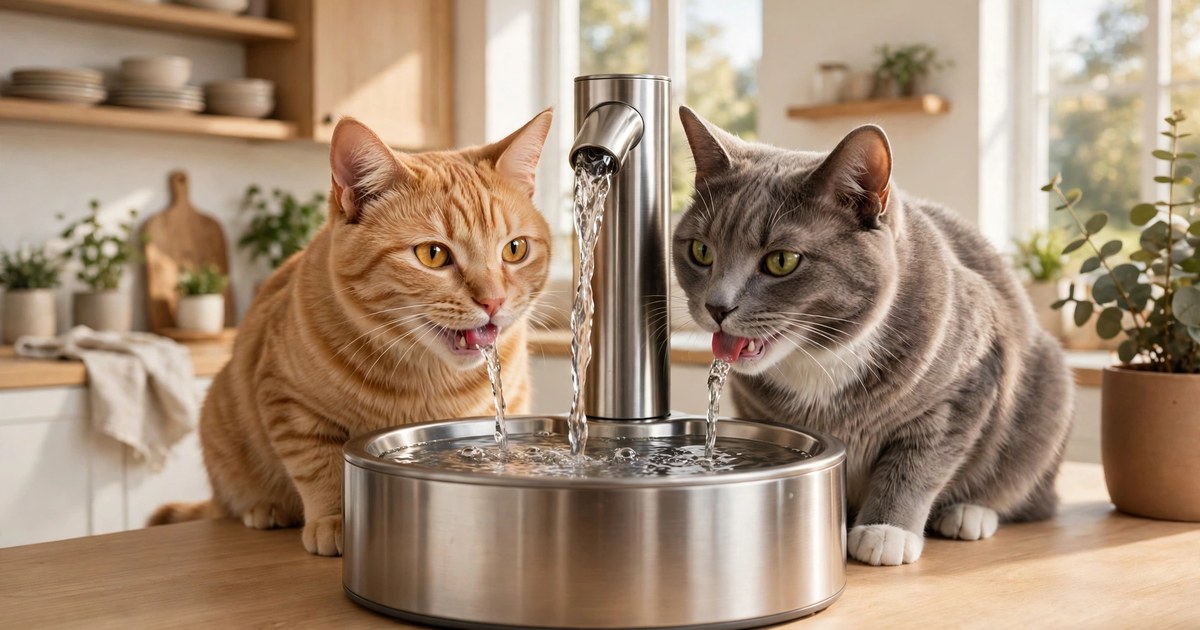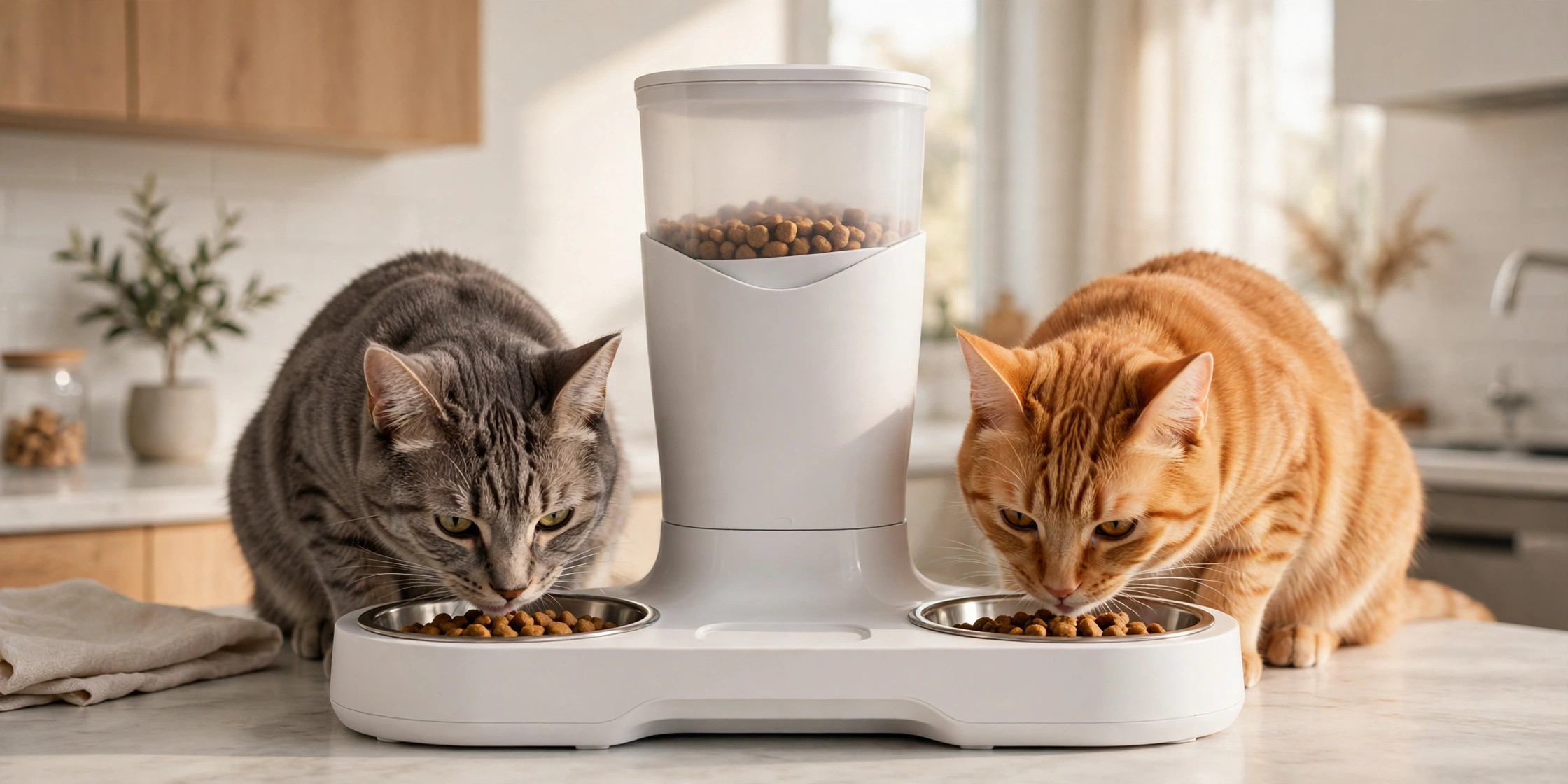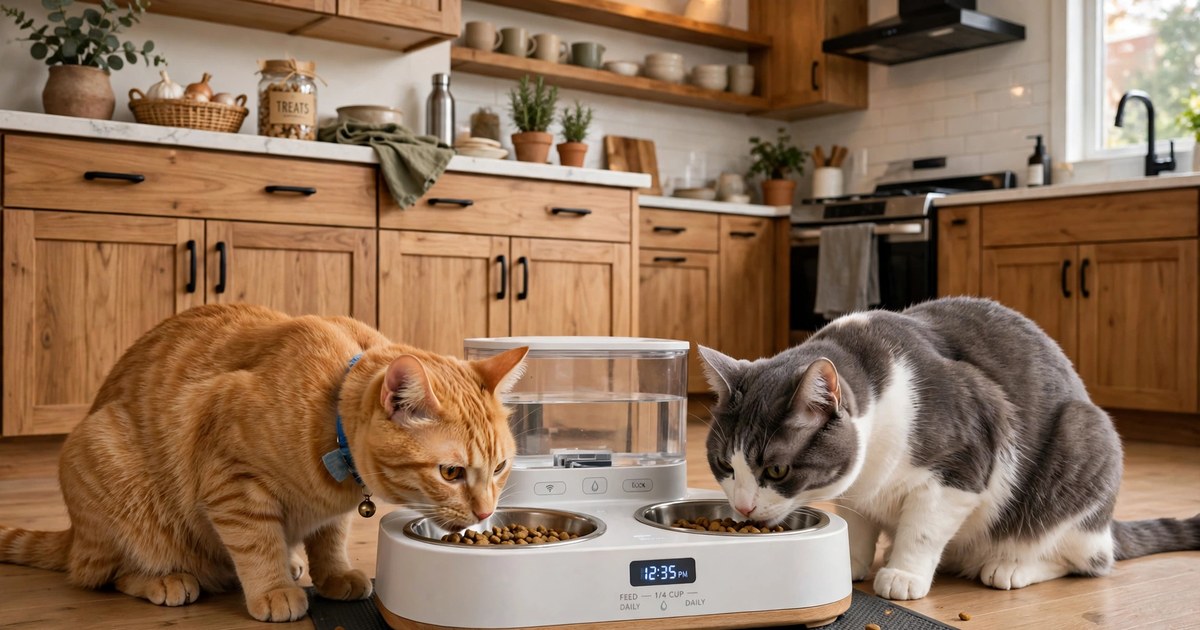
Feeding two cats on a schedule sounds simple until you actually try it. One cat finishes first and steals the other's breakfast. You're refilling two bowls at 6 a.m. before work. And if you travel, your sitter gets a handwritten note that reads like an air-traffic-control manual. An automatic feeder built for two cats promises to fix all of that — but does the WOPET dual feeder actually deliver? This review breaks down what it does well, where it falls short, and who should (and shouldn't) buy it.
Affiliate disclosure: This post contains affiliate links. If you buy through them, CalcPet may earn a commission at no extra cost to you — it keeps our tools and guides free. We never claim to have tested products; our take is based on verified buyer feedback and published product details.
The short verdict
The WOPET Automatic Cat Feeder for Two Cats is the simplest dedicated two-cat feeder we've seen: one hopper splits scheduled meals into two stainless steel bowls at the same time, with a plain LCD timer — no app, no account, no Wi-Fi setup. If your two cats eat the same food and you're tired of manual feeding, it does exactly what it promises. If your cats need different foods or very different portions, you'll want a different solution (more on that below).
WOPET Automatic Cat Feeder for Two Cats
- Dual stainless steel bowls — one hopper feeds two cats simultaneously
- Programmable timer — schedule 1 to 6 meals per day
- 10-second voice recording plays a custom meal call
As an Amazon Associate, CalcPet earns from qualifying purchases.
The big idea is refreshingly practical. Most automatic feeders are single-bowl units: two-cat homes either buy two feeders (and sync them) or let both cats share one bowl and hope the confident cat doesn't eat double. The WOPET sidesteps that with a split-dispensing design — each scheduled meal drops portions into two bowls at the same time, so both cats eat together on the same schedule.
Best for: Two-cat households that feed the same food and want a simple, reliable schedule without apps or accounts. Not ideal for: homes where the two cats need different foods or very different portions — the split bowls deliver equal shares, so diet-separated households should look at microchip-activated feeders instead. Pros: Purpose-built for two-cat homes — one feeder replaces two units; dual power supply (adapter plus battery backup) keeps meals running during outages; simple LCD setup with no app or account; stainless steel bowls are more hygienic than plastic. Cons: Dry food only (2–12mm kibble); both bowls get the same food and roughly the same portion; larger footprint than a single-bowl feeder.
How the WOPET dual feeder works
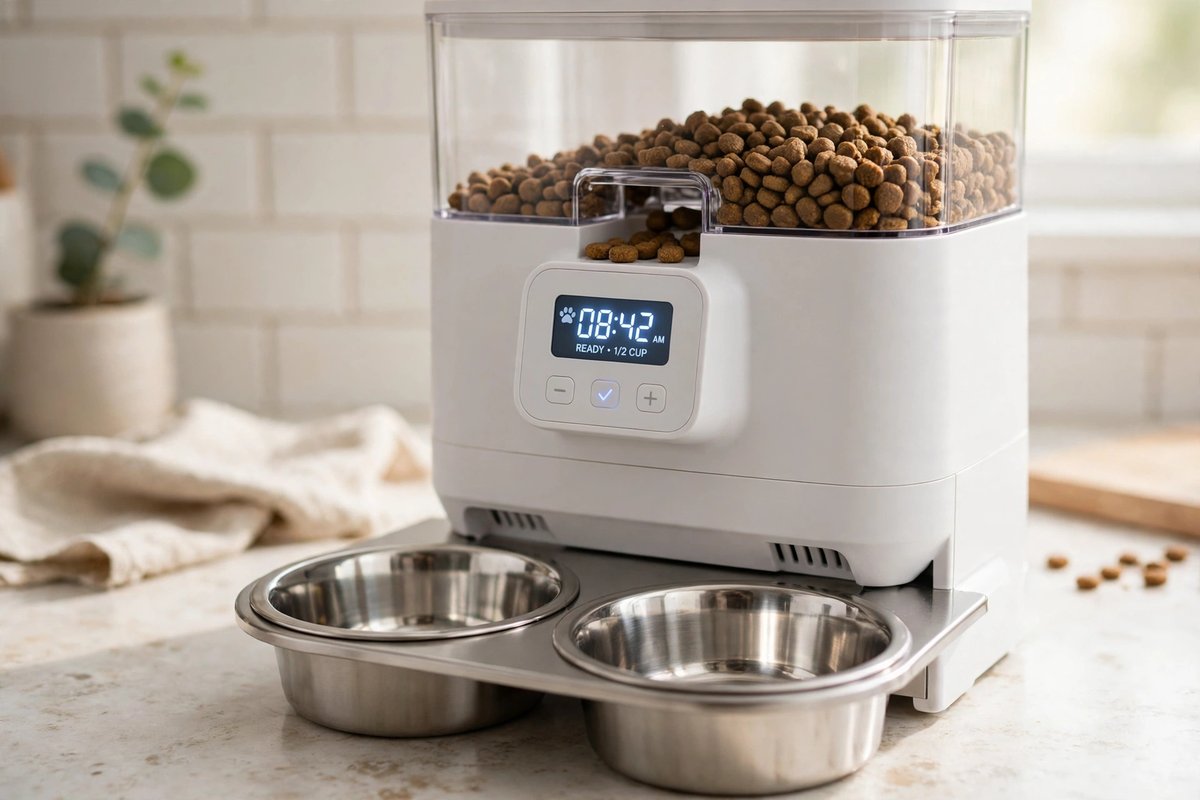
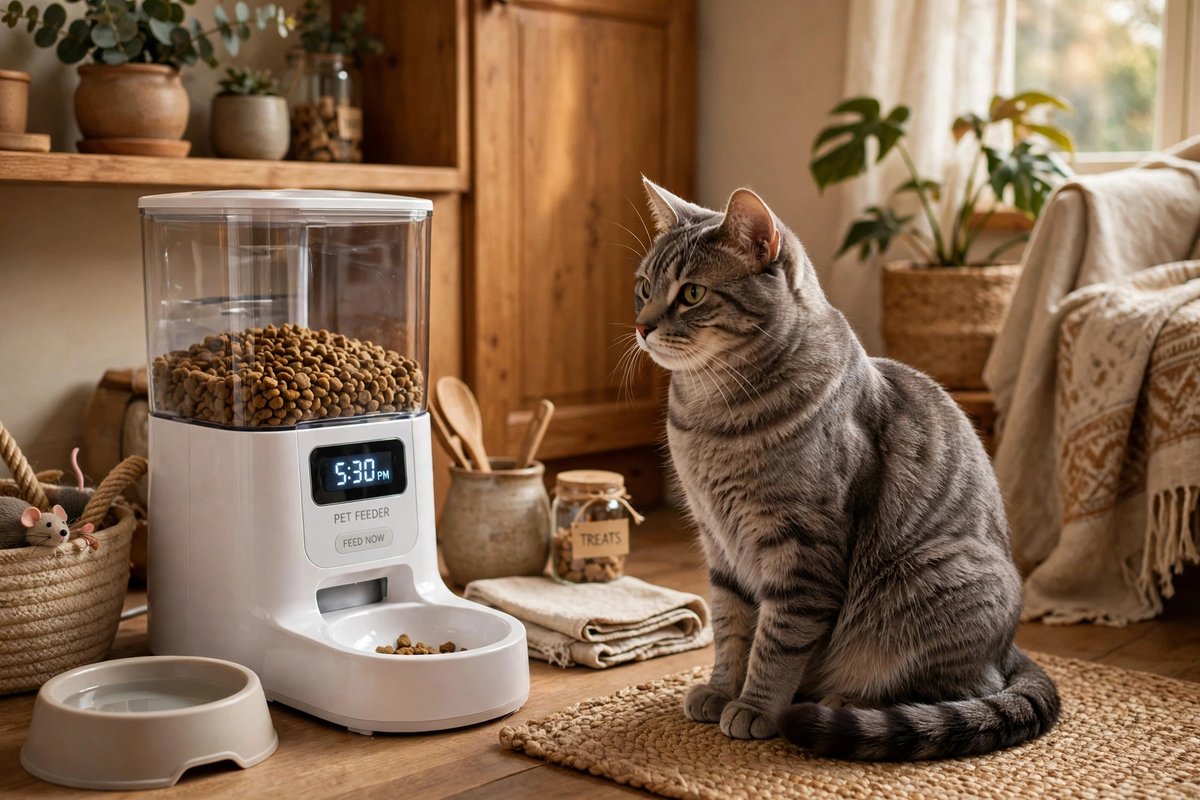
At its core, this is a timer-controlled dry-food dispenser. You pour kibble into the hopper, program up to six meal times on the built-in LCD panel, and set the portion size for each meal. When a meal time arrives, the feeder dispenses kibble through two chutes into two stainless steel bowls — both cats get fed at once.
Three features do most of the heavy lifting:
1. Dual-bowl split dispensing
One hopper, two bowls, simultaneous dispensing. This is the feature that makes it a two-cat feeder rather than just a feeder used by two cats. Each cat eats from its own bowl at the same time, which cuts down on the mealtime crowding and bowl-guarding that single-bowl setups can cause in multi-cat homes.
2. The 1–6 meal timer
Up to six programmable meals per day covers the schedules most owners actually use — a typical two- or three-meal routine with room for extra small meals. The LCD panel setup is deliberately low-tech: physical buttons, a small screen, no smartphone app. For anyone who has ever wrestled with a feeder app that forgot its Wi-Fi credentials, this is a feature, not a limitation.
3. Voice recording meal call
You can record a 10-second message that plays when food dispenses. In practice, owners record a short meal call, and the cats learn to associate the sound with mealtime — handy for pulling both cats to the feeder at once instead of one wandering off.
Setting it up: what to expect
Setup follows a simple sequence — budget about ten minutes for the first run:
- Assemble and place it. The bowls slot into the base; set the feeder on a flat, easy-to-clean surface (a washable mat under it catches the stray kibble every dual-bowl feeder scatters).
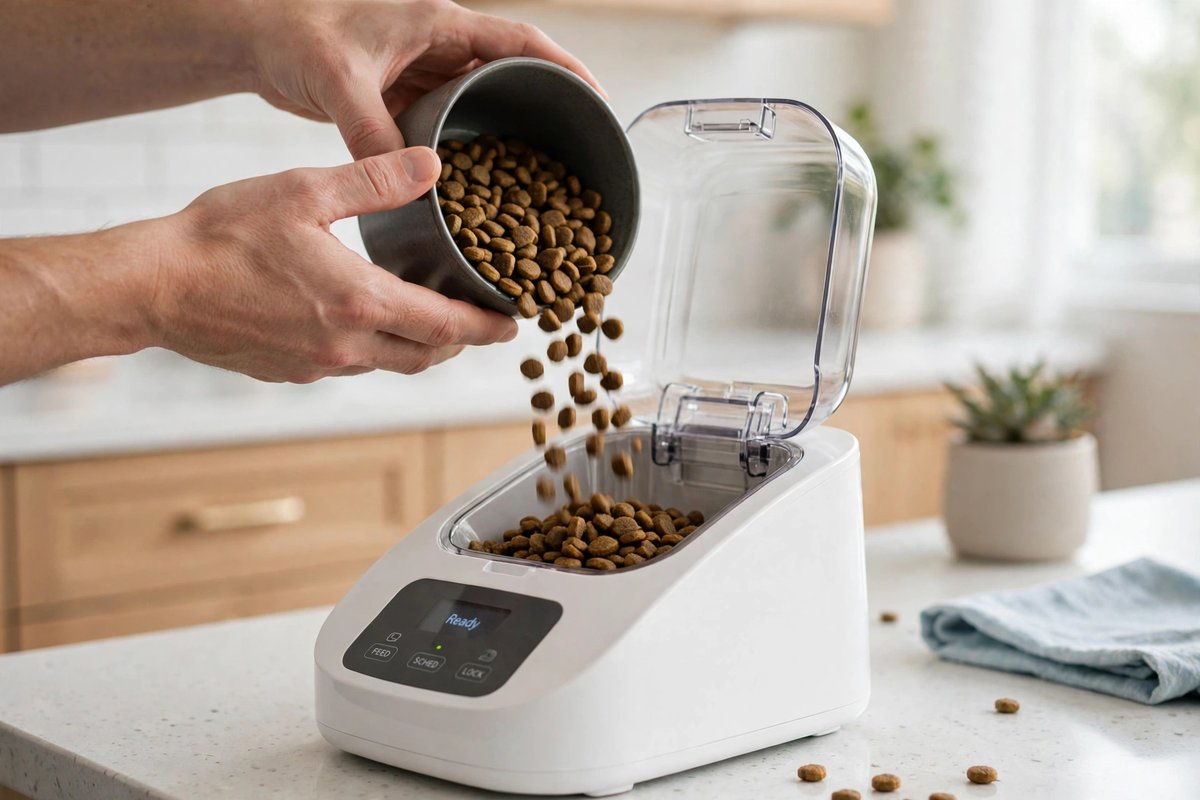
- Fill the hopper with dry kibble only. Stick to 2–12mm kibble — oversized or oddly shaped pieces are the main cause of dispensing jams in any gravity/time-based feeder. The feeder is not designed for wet or semi-moist food.
- Program your meals. Use the LCD panel to set the current time, then add each meal time and its portion size. Start with the routine your cats already know — cats adjust faster to a feeder that follows their old schedule.
- Record the meal call. Record a short 10-second message. Keep it the same phrase every time; consistency is what trains the routine.
- Add backup power. The feeder runs on a power adapter, with battery backup so meals continue during outages. Put fresh batteries in from day one — the day you need them is never the day you remember to.
For the first week, run the feeder while you're home and watch a couple of cycles. Check that both bowls get roughly equal portions and that both cats are comfortable approaching their bowl. Most cats investigate the new object for a day or two before treating it as a food source — that's normal.
Who the WOPET dual feeder is (and isn't) for
It fits well when:
- Both cats eat the same food. This is the key condition. The feeder splits one hopper's kibble between two bowls, so equal food is the whole point.
- You want simplicity over smarts. No app, no Wi-Fi pairing, no account — the LCD timer does the job and there's nothing to forget a password to.
- You travel or work long hours. Scheduled meals plus battery backup means the routine holds whether you're on a late shift or a weekend trip.
- One cat tends to push the other off a shared bowl. Simultaneous dispensing into two bowls reduces the "winner eats everything" dynamic of single-bowl feeding.
Consider alternatives when:
- The cats need different foods or very different portions. Equal split is the design — it can't serve diet food to one bowl and regular kibble to the other. Microchip-activated feeders solve this, at a much higher price.
- You need remote control or feeding alerts. This feeder has no app, so there's no phone notification when a meal dispenses. If you want camera checks and remote top-ups, a Wi-Fi smart feeder is the better category — see our best automatic feeders for two cats roundup for those picks.
- You feed wet food. Like nearly all hopper-style feeders, this one is dry kibble only.
WOPET dual feeder vs. the alternatives
Versus buying two separate feeders: Two single-bowl feeders give you per-cat portion control and independent schedules, but cost roughly double and take up twice the counter space — plus you have to program both. The WOPET wins on cost and simplicity when the cats eat the same food; two feeders win when they don't.
Versus a smart/Wi-Fi feeder: App-controlled feeders add remote feeding, feeding logs, and alerts, but they add setup complexity and usually only serve one bowl — you'd still need two for two cats. The WOPET trades smarts for a dual-bowl design at a friendlier price. If monitoring matters more to you than dual bowls, start with the Pet Parent Picks hub to compare feeder types.
Versus microchip feeders: Microchip or collar-tag feeders are the gold standard for diet-separated multi-cat homes, but they cost several times more and each cat needs its own unit. The WOPET is the budget-friendly choice for same-food households.
Care tips: keeping it running well
- Stick to 2–12mm kibble. Oversized pieces are the #1 cause of jams in timer feeders.
- Wash the bowls weekly. Stainless steel is easier to keep clean than plastic and less likely to harbor the residue that bothers sensitive cats — but it still needs a regular wash.
- Wipe the hopper monthly. Kibble dust and oils build up; a quick wipe keeps the dispensing mechanism moving freely.
- Keep backup batteries fresh. Swap them on a schedule (say, every six months) rather than waiting for an outage to discover they're dead.
- Watch the food level. Refill before the hopper runs low — dispensing gets uneven when the feeder is nearly empty, and a mat underneath catches the strays.
The verdict
The WOPET dual feeder succeeds because it picks one job — scheduled meals for two same-food cats — and does it without complexity. No app to configure, no second feeder to sync, no crowding at a single bowl. Its limits are honest ones: dry food only, equal portions, and no remote monitoring. For the two-cat household it was built for, that's a fair trade — and a meaningful upgrade over the 6 a.m. manual routine.
If you want to compare it against smart and app-controlled options first, our best automatic feeders for two cats roundup covers the full landscape. And if your cats are different ages, our cat age calculator is a quick way to sanity-check whether their feeding routines should match at all. For general guidance on feeding routines, the ASPCA's cat care guide and VCA Hospitals' nutrition guidelines are solid references.
Frequently asked questions
Can the WOPET dual feeder give different portions to each cat?
Not really — both bowls receive the same food from one hopper at roughly equal portions. If your cats need meaningfully different amounts, two separate feeders or per-pet scheduled units are a better fit.
Does the WOPET dual feeder need Wi-Fi?
No. It's programmed entirely through the built-in LCD panel and buttons — there's no app, no account, and no Wi-Fi pairing involved.
What kind of food works in it?
Dry kibble sized 2–12mm. It's not designed for wet, semi-moist, or raw food, and oversized kibble can jam the dispensing mechanism.
What happens during a power outage?
The feeder has dual power: it normally runs on the adapter, with battery backup that keeps the schedule running through outages. Keep fresh batteries installed so the backup is ready when needed.
Is it suitable for one cat and one small dog?
The manufacturer lists it for cats and small dogs, and the equal-split design works the same way — as long as both animals eat the same dry food and are comfortable sharing a feeding station.
How often will I need to refill it?
That depends on portion sizes and the number of meals, but with two cats on a typical schedule most owners refill every several days. Refill before the hopper gets near-empty, since dispensing gets uneven at low levels.