A kitten sees your home very differently from the way you do. Where you see a tidy living room, a kitten sees a climbing frame, a chew toy, and a dozen gaps small enough to squeeze into.
That is why kitten-proofing matters before day one, not after the first scare. The good news: most of it is not buying things — it is tidying, shutting doors, and looking at each room from kitten height. Work through the checklist below, set up one safe room, and your kitten's first week will be calmer for both of you.
Start With the Kitten-Height Walk-Through
Before you buy a single gadget, do this one thing: get down on your hands and knees in every room. Anything you can reach, pull, chew, or squeeze behind, a kitten can too. Look for dangling cords, open cupboards, small objects, gaps behind appliances, and windows that open more than a crack.
Do the walk-through the day before your kitten arrives, then again after the first week. A home proofed for a 10-week-old kitten is often not proofed for the same cat at six months, when it can jump onto counters and high shelves. Proofing is a habit, not a one-time job.
The Kitten-Proofing Checklist: 20 Things to Do Before Day One
Work through the list room by room. If you are short on time, start with items 1, 6, 13, and 16 — cords, kitchen chemicals, windows, and lilies matter most.
Living Room and Bedroom
- Hide or cover electrical cords. Run TV, lamp, and charger cables through cord covers or behind furniture. Teething kittens chew cords, and a chewed live cord is a common danger.
- Tie up blind and curtain cords. Wind dangling cords high out of reach with a cord cleat, or cut the loop. Loose cords are a strangling risk, and kittens bat at anything that dangles.
- Pick up small objects daily. Rubber bands, hair ties, paper clips, thread, and dental floss are all swallowable. A quick evening floor sweep takes two minutes and prevents most choking scares.
- Block gaps behind and under furniture. Fill gaps behind the TV stand and under low dressers with rolled towels or foam insulation. Kittens wedge into gaps and can get stuck, especially behind recliners.
- Secure heavy or wobbly items. Anchor tall bookshelves and TVs to the wall, and move fragile ornaments off low shelves. A kitten's first climbs are clumsy, and a falling shelf is dangerous for a two-pound animal.
Kitchen
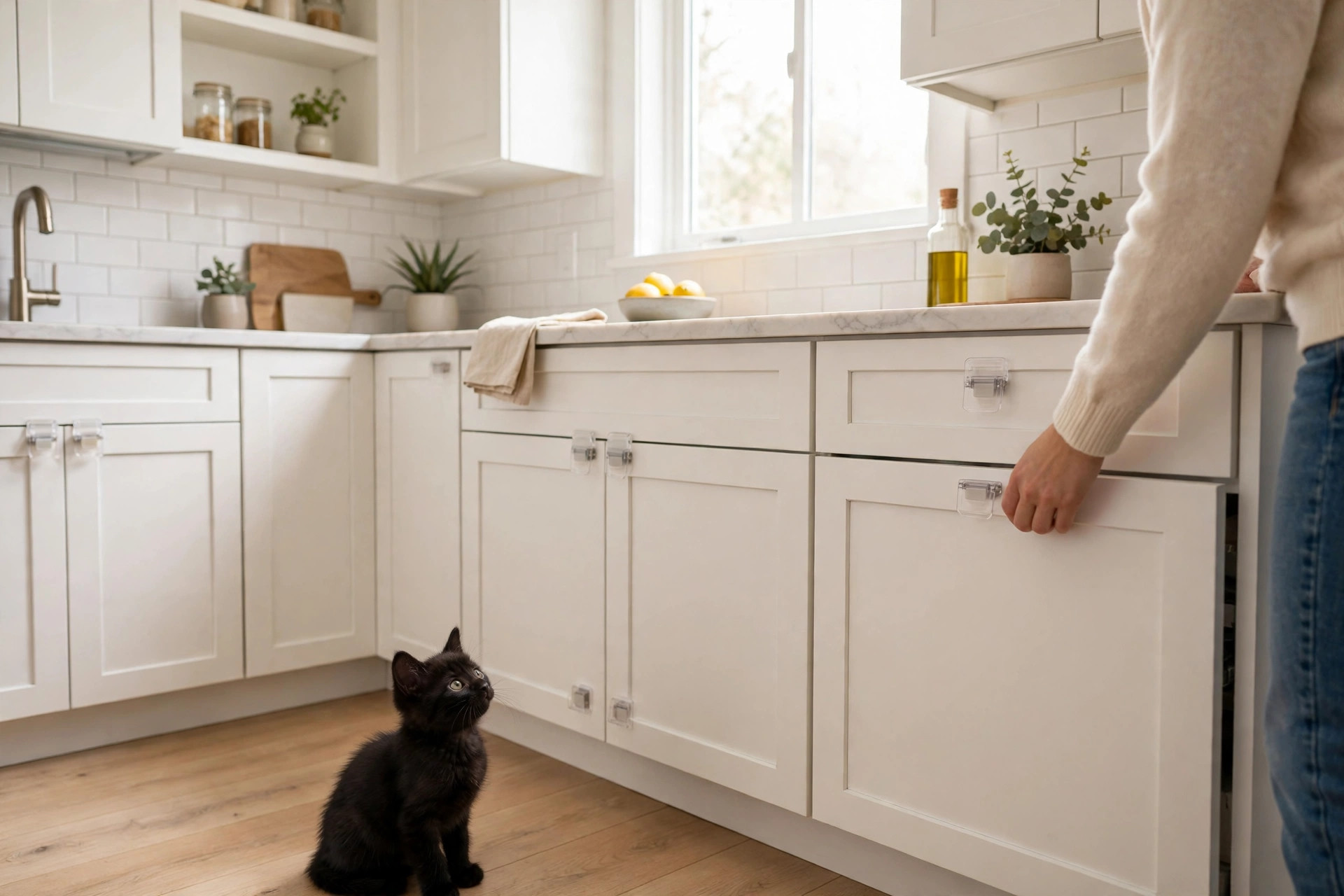
- Lock away cleaning products. Move detergents, dishwasher tablets, and sprays into a high cupboard or fit a latch on the under-sink cabinet. If a product is in a low cupboard, assume your kitten will find it.
- Keep the stove and oven off-limits. Cover stove knobs or remove them if your kitten jumps onto counters, and keep the oven door shut. A kitten can slip inside an open oven unnoticed.
- Store food and rubbish out of reach. Use a bin with a secure lid, and never leave food scraps or plastic wrap where a kitten can grab them. Chicken bones, onion, garlic, and chocolate should never be within a cat's reach.
- Check the fridge and dishwasher before closing. Kittens climb into open appliances. Look inside before you shut the door or press start.
Bathroom and Laundry
- Close toilet lids and empty buckets. A small kitten can fall into an open toilet or a bucket of water and struggle to climb out. Keep lids down and buckets empty or upside down.
- Move medicines and toiletries up high. Store human medicines, vitamins, and razors in a closed medicine cabinet, never on an open shelf. Even a single dropped pill is a serious risk for a kitten.
- Keep the washer and dryer shut. Always check inside before starting a load, and keep the doors closed between uses. Warm laundry is one of the most attractive hiding spots in the house.
Windows, Balconies, and Doors
- Fit secure screens on every window you open. Screens must be snug and firmly wedged into the frame — a loose flyscreen is not kitten-proof, and a kitten can push it out. Childproof window guards alone are not enough, because cats can slip through them.
- Enclose or block balcony access. Keep the balcony door shut until it is fully enclosed with cat-safe netting. A kitten can slip through railings that look far too narrow to an adult eye.
- Watch doors and recliners. Close doors gently, and check under recliners and rocking chairs before moving them. Kittens hide underneath furniture, and a moving recliner can trap a paw or a tail.

Plants, Chemicals, and Small Objects
- Remove lilies from the home completely. True lilies and daylilies are the biggest plant danger for cats — every part, including pollen and vase water, is dangerous. Do not just move them to another room; take them out of the house, and ask visitors not to bring them.
- Audit every other houseplant. Move pothos, monstera, aloe vera, and jade plants out of reach, and replace them with cat-safe options such as spider plants or Boston ferns. When in doubt, look the plant up before you buy it.
- Lock away garage and garden chemicals. Antifreeze, pesticides, snail bait, and rodent bait belong in a locked cupboard or shed, never on a low shelf in the garage.
- Put away thread, yarn, and string. Sewing supplies, ribbon, and tinsel are irresistible to kittens and dangerous if swallowed. Keep craft supplies in closed boxes, and never leave a kitten unsupervised with a string toy.
- Do a final floor check every night. Walk the rooms your kitten uses and pick up anything small, dangling, or chewable. Two minutes a night keeps the checklist working long after day one.
Set Up One Safe Room First
Do not open up the whole house on day one. Start your kitten in one quiet room with everything it needs, and let it explore the rest of the house gradually over the first week.
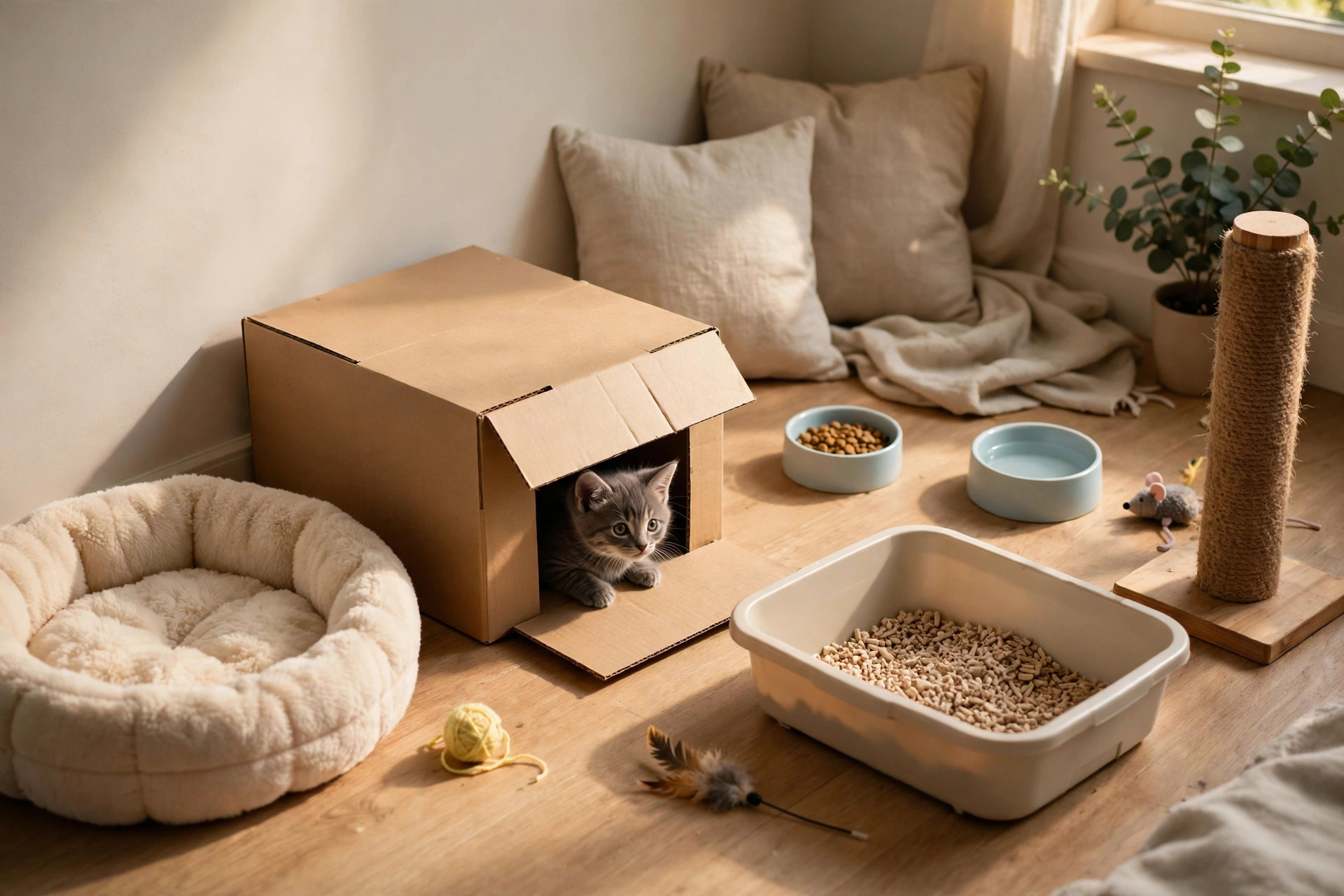
- Pick a quiet room with a door that closes — a spare bedroom works best.
- Put a low-sided litter box in one corner, with unscented litter to start.
- Place food and water bowls in a different corner, away from the litter box.
- Add a bed and a hiding spot — a soft bed plus a cardboard box with a doorway cut in it.
- Add a scratching post and two or three toys, so the kitten has something to scratch and chase that is not your furniture.
- Close the room off and keep other pets and young children out for the first few days.
For the full first-week routine, see our New Kitten Checklist: Your First Week Survival Guide.
The First 48 Hours: A Simple Plan
Day 1: Bring your kitten home in a secure carrier and place it straight into the safe room. Open the carrier door and let the kitten come out on its own. Show it the litter box, food, and water, then leave it alone to explore. Sit quietly in the room for a while so it gets used to your voice and smell.
Day 2: Keep the kitten in the safe room, but add a short play session — five to ten minutes, twice a day, with a wand toy. Open one new room at a time for short, supervised visits. If the kitten hides, let it hide; confidence comes faster when a kitten is never forced.
If you adopted an adult cat instead, the same safe-room method works; our guide to pet-proofing your home for a cat covers the adult-cat version room by room.
Recheck As Your Kitten Grows
Kitten-proofing is not a one-time job, because a kitten's abilities change fast. Plan three re-checks:
- 8–12 weeks: The kitten is small and curious about everything at floor level. Focus on small objects, cords, and gaps, and keep the safe room as its home base.
- 3–6 months: Teething starts, so chewing ramps up — cords and furniture edges need a second pass. The kitten can now jump onto counters, so move anything breakable up another shelf.
- 6–12 months: Your kitten is nearly full-sized and can reach high shelves and open unlatched cupboards. Do a full walk-through again, checking the high places you ignored before.
What to Do If Your Kitten Gets Into Something
Even a well-proofed home has surprises. If your kitten chews a plant, swallows a small object, or gets into a chemical, stay calm and act quickly: remove the item, keep the packaging or plant so you can describe it, and do not try home remedies or make your kitten vomit unless a vet tells you to. Call your vet straight away, or the ASPCA Animal Poison Control Center for guidance.
Frequently Asked Questions
When should I kitten-proof my home?
The day before your kitten arrives, at the latest. Do the walk-through and set up the safe room while the house is still empty — it is far harder to proof a room with a curious kitten underfoot.
Do I need to buy special kitten-proofing products?
Usually not. Most kitten-proofing is tidying, shutting doors, and moving things up high. Cord covers, cabinet latches, and window screens are the only purchases most owners need.
Are lilies really that dangerous for kittens?
Yes. True lilies and daylilies are the most dangerous common houseplant for cats — every part, including pollen and vase water, is hazardous. Keep lilies out of the home entirely, and ask visitors not to bring them.
How long should my kitten stay in the safe room?
Most kittens need two to seven days. Let the kitten set the pace — open one new room at a time for short, supervised visits.
Is kitten-proofing different from puppy-proofing?
Yes, in one big way: kittens climb. Puppies mostly stay at floor level, while kittens jump onto counters, shelves, and wardrobe tops within a few months. If you have both, compare the two checklists — our dog-proofing checklist for puppies covers the floor-level side.
What is the one thing people forget most when kitten-proofing?
The washing machine and dryer. Kittens love warm laundry, and owners forget to check inside before starting a load. Make "check inside, then shut the door" a habit from day one.
Conclusion
Kitten-proofing is not about turning your home into a fortress. It is about one careful walk-through at kitten height, twenty small fixes, one safe room, and a habit of re-checking as your kitten grows. Do that, and your kitten gets a safe home to explore — and you get to enjoy the fun parts of kitten ownership.
Once your kitten is settled in, find out how old it really is in human years with our cat age calculator — and keep learning from the ASPCA's general cat care guide and the Cornell Feline Health Center.