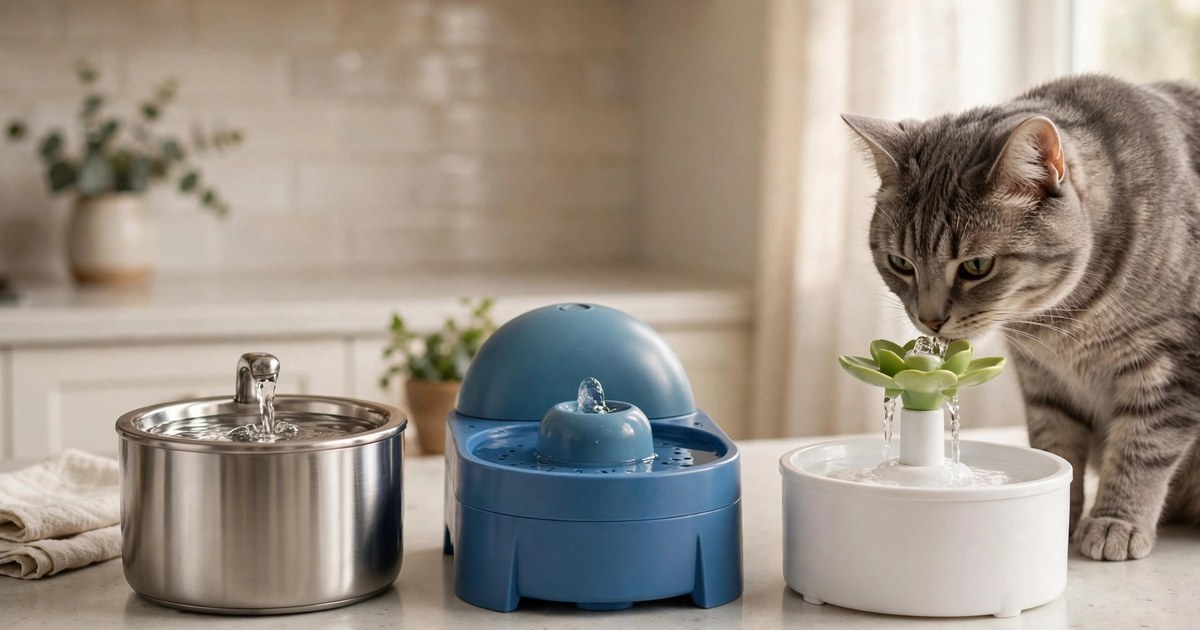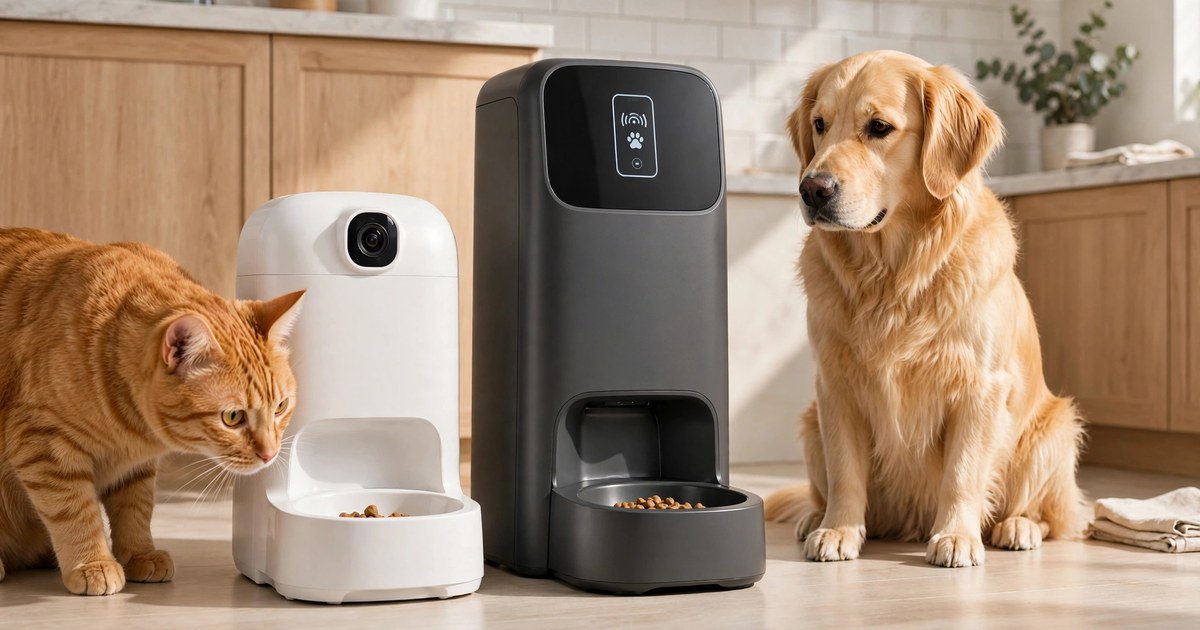
Automatic pet feeders all do the same basic job: they drop kibble on a schedule so your cat or dog eats on time even when you are not home. Camera feeders do that job and let you watch it happen from your phone. The real question is whether that extra set of eyes is worth the extra money — because the price jump is significant.
In this guide I will break down exactly what a camera feeder gives you, where it falls short, and when a regular feeder is the smarter buy. Then I will compare four top-rated picks from the CalcPet catalog — two with cameras and two without — so you can match the right feeder to your home, your pets, and your budget.
Affiliate disclosure: This post contains affiliate links. As an Amazon Associate, CalcPet earns from qualifying purchases — it costs you nothing extra and helps us keep the tools and guides free.
The Short Answer: Should You Pay for the Camera?
Get the camera if: you travel, work long or unpredictable hours, have an anxious or brand-new pet, or simply want visual proof that dinner was actually served and eaten. Skip the camera if: you are home most of the day, you already own a home camera pointed at the feeding spot, or a reliable schedule is all you need — a regular feeder does the core job for less.
What a Camera Feeder Actually Gives You
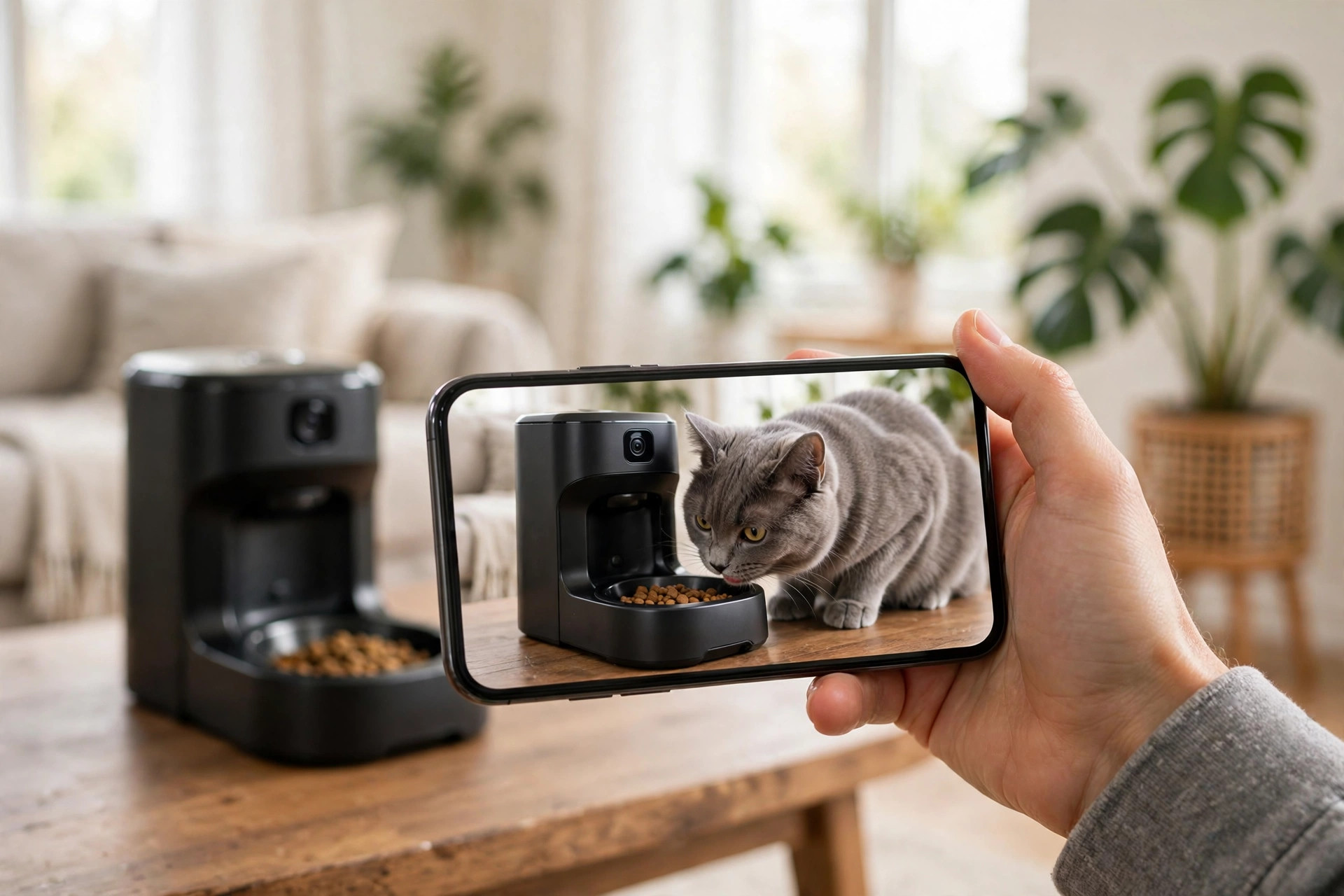
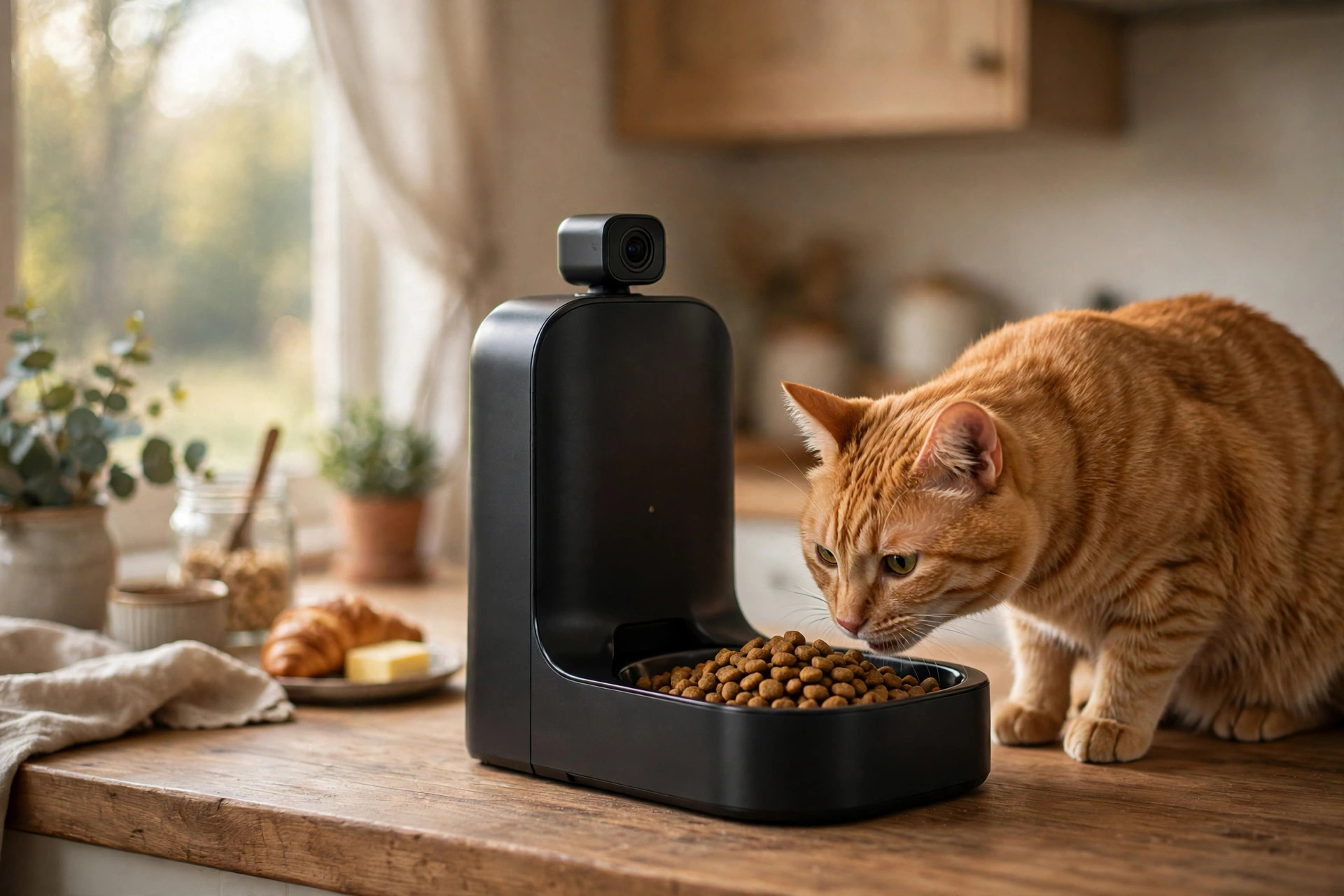
Camera feeders combine an automatic food dispenser with a small Wi-Fi camera, usually 1080p with night vision, pointed right at the bowl. Here is what that buys you in practice:
- Meal-time visual confirmation. Instead of guessing whether food dropped or your pet showed up, you see it. Many models save short clips or send motion alerts when your pet approaches the bowl.
- Two-way audio. Most camera feeders include a speaker and microphone, so you can talk to your pet — or be woken by meows, depending on your pet.
- Peace of mind for anxious owners. If you worry about your cat or dog when you are away, seeing them eat calmly is genuinely reassuring.
Be honest with yourself about the limits, though. A camera shows you the bowl, not the whole pet. It will not tell you exactly how much was eaten (especially in multi-pet homes), and the live view depends on stable Wi-Fi. The camera is a window, not a caretaker.
When a Regular Feeder Is the Smarter Buy
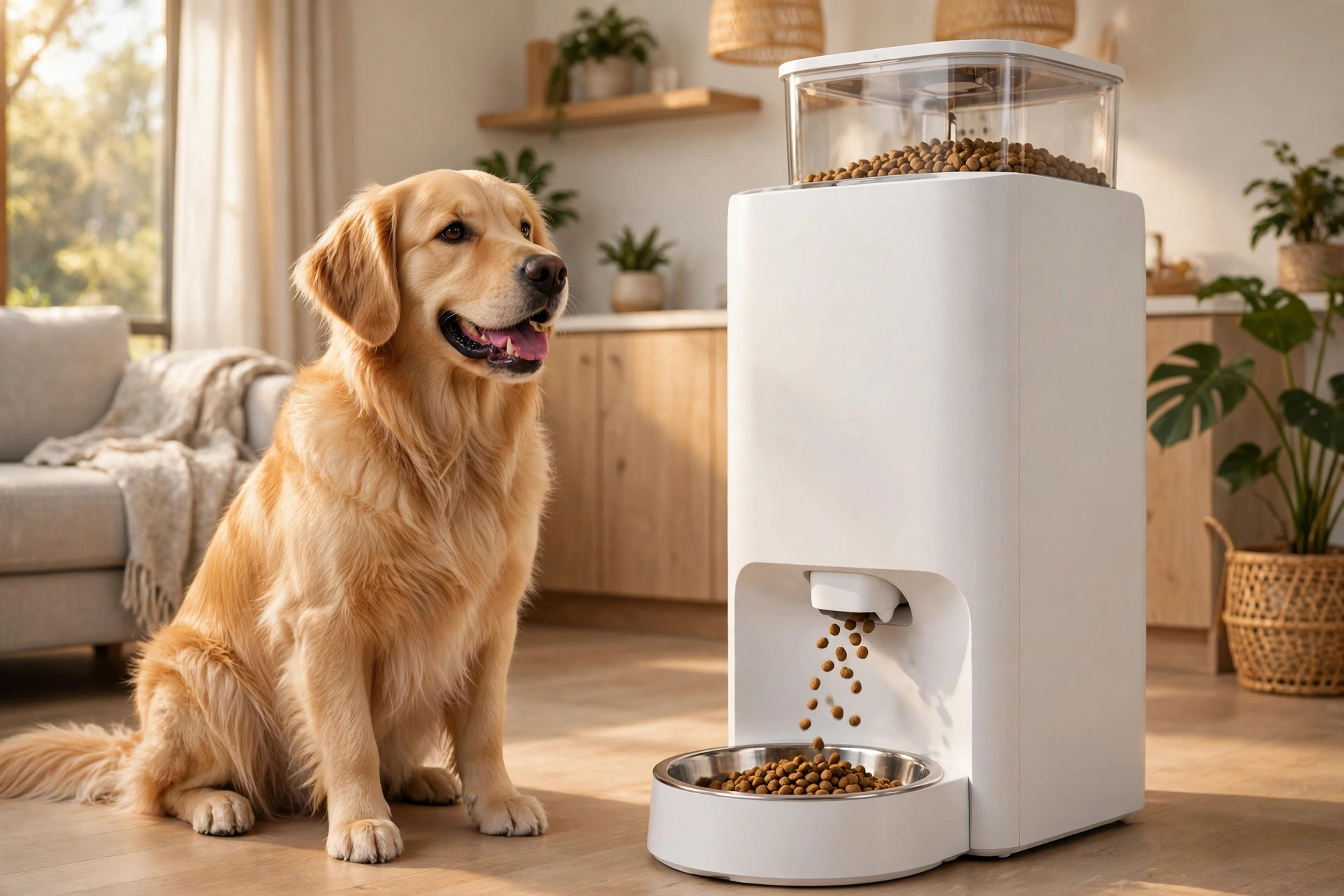
A regular automatic feeder — timer or Wi-Fi — dispenses scheduled portions without any video. It is simpler, cheaper, and in many homes it is all you need:
- You are home most of the time. If someone is usually around, a camera adds little.
- You already have a pet camera. A standalone indoor camera pointed at the feeding area does the same job — often better, since feeder cameras can be laggy and lack real night vision.
- Reliability matters most. Fewer components means fewer things that can fail. A scheduled meal drops whether or not your Wi-Fi is cooperating.
- Budget. Solid Wi-Fi feeders cost noticeably less than camera models with the same dispensing quality.
The 4 Picks: Camera vs Regular, Head to Head
I compared two camera feeders and two regular feeders from the CalcPet catalog — all rated by thousands of verified Amazon buyers — so you can see exactly what the price jump buys.
PETLIBRO Automatic Cat Feeder with Camera (1080p)
- 1080p HD camera with night vision and 2-way audio
- Stainless steel slow-feed tray; app scheduling with motion alerts
- #1 ranked in Automatic Cat Feeders on Amazon
As an Amazon Associate, CalcPet earns from qualifying purchases.
My take: This is the camera feeder to beat. With ~11,700 ratings behind it and a #1 ranking in its Amazon category, it is the safest bet if you want the full camera experience: 1080p video, night vision, two-way audio, motion alerts, and a slow-feed tray that suits fast eaters. Top-rated by verified buyers, not by us.
Pros: Check in on pets visually at mealtimes, day or night; slow-feed tray design suits fast eaters; strong rating base (~11,700 ratings).
Cons: Priciest option in this roundup; camera features need a stable Wi-Fi connection; single tray — not ideal for two cats.
Best for: Owners who want to watch their pets at mealtime.
PETLIBRO Camera Feeder (Single Tray, Compact)
- 1080p camera with night vision in a compact body
- Single stainless steel tray; app control with 2-way audio
- Motion alerts when your cat approaches
As an Amazon Associate, CalcPet earns from qualifying purchases.
My take: Same camera peace of mind, smaller footprint. If you have one cat and a crowded countertop, this is the practical middle ground: 1080p camera, night vision, two-way audio, motion alerts, and a 24-month warranty — all in a compact body. The single tray is the tradeoff.
Pros: Camera peace of mind in a smaller footprint; ranked in the top 20 of Automatic Cat Feeders; 24-month warranty included.
Cons: One tray only — not for multi-cat homes; camera adds cost over non-camera models; needs steady Wi-Fi for a smooth live view.
Best for: Single-cat homes short on space.
PETLIBRO Granary Automatic Pet Feeder (WiFi, 5L)
- 5L hopper with 5G/2.4G Wi-Fi app control — up to 10 meals per day
- Freshness preservation with desiccant bag plus low-food sensor alerts
- Twist-lock lid keeps clever paws out of the food hopper
As an Amazon Associate, CalcPet earns from qualifying purchases.
My take: This is the best regular feeder in the catalog, full stop. You lose the camera but keep everything else that matters: flexible app scheduling (up to 10 meals a day), a 5L hopper that suits cats and small-to-medium dogs, freshness preservation, and low-food alerts. A ~10,000-rating review base makes it one of the most trusted feeders in its price range.
Pros: Huge review base (~10,000 ratings) for a feeder in this range; flexible app scheduling suits shift workers and travelers; made for both cats and small-to-medium dogs; 24-month warranty.
Cons: Wi-Fi setup can be fiddly on 5G-only networks; replacement desiccant bags are an ongoing cost; dry kibble only — no wet food support.
Best for: App-controlled scheduled feeding for cats and small dogs.
PetSafe Smart Feed Automatic Pet Feeder (6L)
- Large 6L (24-cup) hopper — fewer refills per week
- Schedules up to 12 meals/day, 1/8 to 4 cups per meal
- Slow-feed mode dispenses over 15 minutes; works with Alexa
As an Amazon Associate, CalcPet earns from qualifying purchases.
My take: The regular feeder for dog households. The 6L hopper holds enough for large dogs or several days of feeding, schedules up to 12 meals a day, and the slow-feed mode stretches dispensing over 15 minutes for gulpers. From PetSafe, a US pet brand established in 1998. It is bulkier than the PETLIBRO picks, but capacity is the point.
Pros: Big capacity suits large dogs; handles dry and semi-moist kibble without jamming; from PetSafe, a US pet brand established in 1998.
Cons: Bulky footprint on the counter; some owners report app connectivity hiccups; smaller review base than the category leaders.
Best for: Large dogs, multi-pet homes needing big capacity.
Side-by-Side Comparison
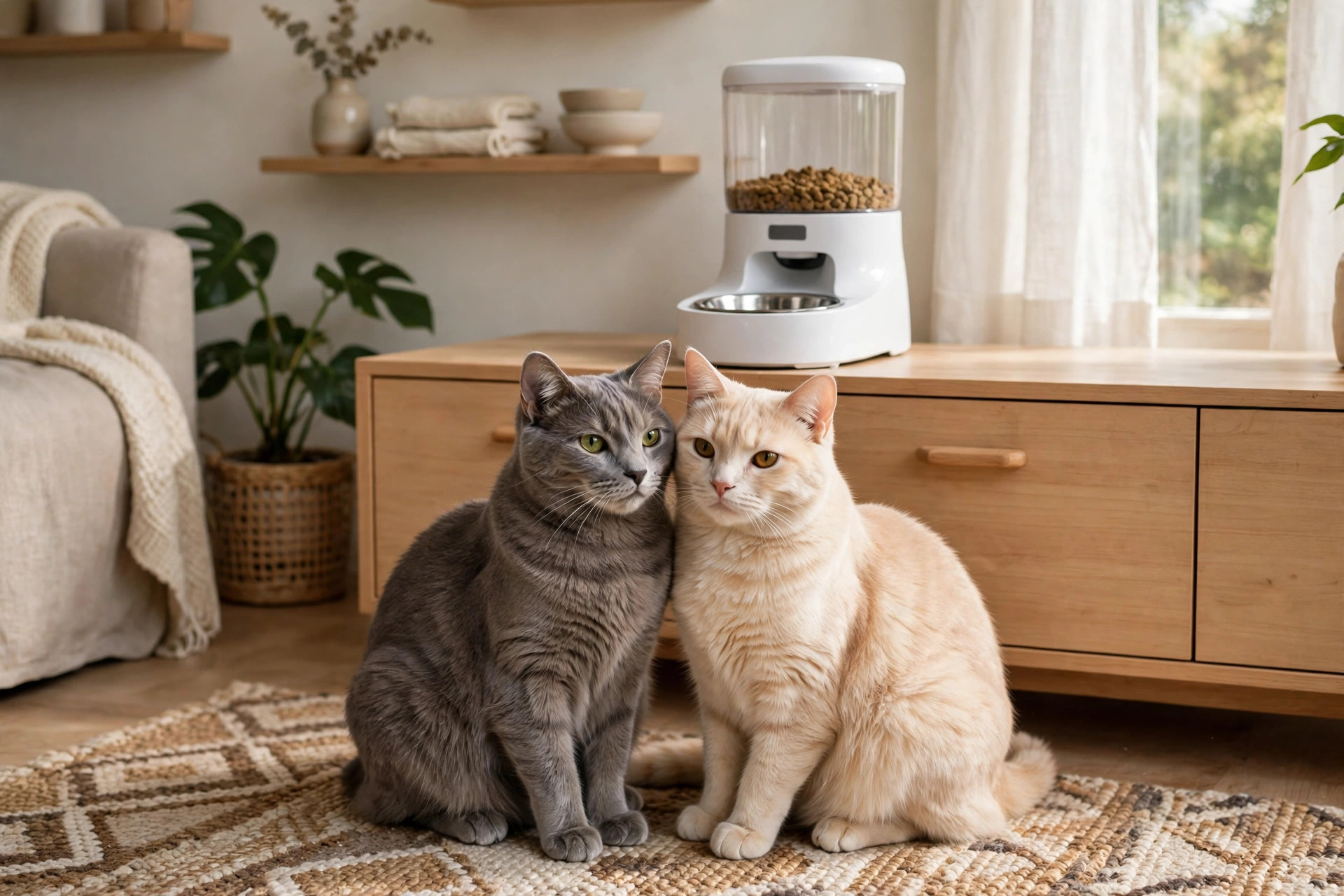
| Feeder | Camera | Capacity | Rating base | Best for |
|---|---|---|---|---|
| PETLIBRO Camera Feeder (1080p) | Yes — 1080p, night vision, 2-way audio | Single tray | ~11,700 ratings | Full camera experience |
| PETLIBRO Camera Feeder (Compact) | Yes — 1080p, night vision, 2-way audio | Single tray | Top 20 category | Small spaces, one cat |
| PETLIBRO Granary (WiFi, 5L) | No | 5L | ~10,000 ratings | Cats & small dogs, app control |
| PetSafe Smart Feed (6L) | No | 6L (24 cups) | ~2,100 ratings | Large dogs, multi-pet homes |
Buying Guide: 6 Questions to Decide Before You Pay
- How often are you away? Out all day or traveling regularly → camera. Home-based → regular.
- Do you already own a pet camera? If a camera already watches the feeding spot, paying for one inside the feeder is redundant.
- One pet or several? All four picks here are single-tray; in multi-pet homes, bowl guards and staggered schedules matter more than a camera. See our PETLIBRO vs PetSafe brand comparison for how the brands stack up overall.
- How reliable is your Wi-Fi? Camera features die with the connection; schedules stored on the feeder usually survive. In a dead-zone house, a regular feeder is more dependable.
- What is the total cost? Compare the camera premium, not the sticker price: the same-quality dispenser without a camera is always cheaper. Ask yourself what that difference buys — a visual check-in, nothing more.
- Cat or dog? Cats do fine with compact 5L models; large dogs need 6L+ hoppers. Our 7 best automatic pet feeders roundup covers more sizes if none of these four fit.
For a second opinion on the basics, the AKC's guide to automatic feeders is a solid reality check: feeders are tools, not replacements for your role in your pet's routine. The ASPCA's cat care guidance and International Cat Care are worth bookmarking for general feeding know-how.
The Verdict
The camera is worth it if you will actually use it — frequent travelers, long workdays, anxious new-pet owners. For those buyers, the PETLIBRO Camera Feeder (1080p) is the top-rated choice, and the Compact version keeps the same core features for smaller homes.
For everyone else, the PETLIBRO Granary (WiFi, 5L) delivers the same app scheduling and reliability without the camera premium — and dog households should look at the PetSafe Smart Feed (6L) for the capacity. You can browse all our recommendations on the Pet Parent Picks page.
FAQs
Do camera pet feeders work without Wi-Fi?
Feeding usually continues on the saved schedule even if Wi-Fi drops, but the live camera view, motion alerts, and remote schedule changes all need a connection. If your internet is flaky, a regular feeder is the safer core choice.
Are camera feeders safe to leave running all day?
Yes, from a device standpoint — they use low power and are designed for continuous use. The main safety rule is the same as any feeder: keep cords out of chewing reach and place the unit on a stable, level surface.
Can I see my pet at night with a camera feeder?
Both PETLIBRO camera models in this comparison include night vision, so yes — you can check in after dark. The video is grainier than daylight footage, but you can clearly see whether your pet visited the bowl.
Is a camera feeder worth it for one cat?
Often yes, if you are away regularly — one cat, one bowl, and a clear camera view is the ideal setup. If you are home most of the day, the regular PETLIBRO Granary does the same feeding job for less.
Do regular feeders still work during a power outage?
Many automatic feeders have battery backup that keeps the clock and schedule running during outages — check the specific model's specs. Camera functions typically do not run on backup power.
Can two cats share one of these feeders?
Only if they eat the same food and tolerate sharing — all four picks here have a single tray. For two cats on different diets or one food thief, you need separate feeders or access-controlled models.
Conclusion
A camera turns a feeder into a window; it does not change the food. Buy the camera for the peace of mind, buy the regular feeder for the schedule — and match the capacity to your pet. Before you decide, it is worth running the numbers on the real cost of your setup with our free Dog Cost Calculator — a feeder that pays for itself in saved pet-sitter visits is an easy yes.