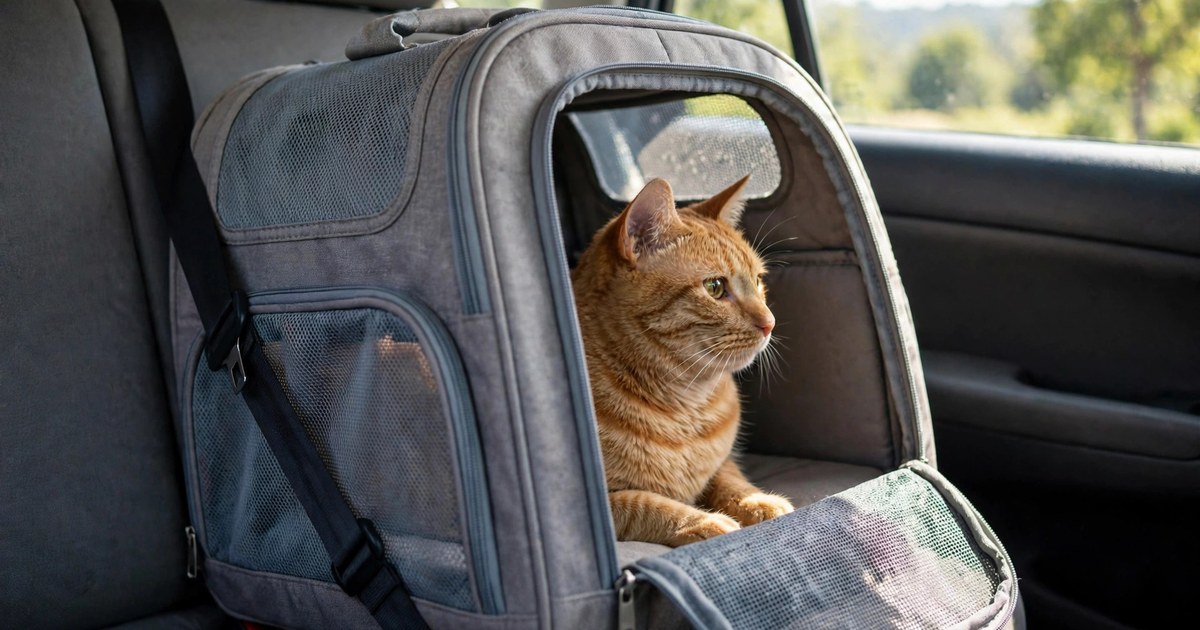
A loose pet in a moving car is a danger to everyone inside it — including the pet. A sudden stop can turn a 10-pound cat into a heavy projectile, and a nervous dog climbing into the driver's lap is a crash waiting to happen. The fix is simple and cheap: a good carrier, secured to the seat, that your pet actually tolerates. The right carrier keeps your pet in one safe place, keeps the driver focused, and turns road trips from a wrestling match into a calm ride.
We compared the carriers real owners actually drive with and picked four that cover every kind of road trip, from the quick vet run to the cross-country move. Every pick below is a proven, top-rated Amazon carrier — and every one secures to a car seat with a seatbelt or tether, so it stays put when the road gets interesting.
Affiliate disclosure: This post contains affiliate links to Amazon. If you buy through them, CalcPet may earn a commission at no extra cost to you — it helps us keep our free pet tools running. We only feature products with strong, verified buyer track records, and ratings quoted are from Amazon buyer reviews and can change.
Quick picks: the best pet carriers for car travel at a glance
- Best overall: Henkelion Soft-Sided Pet Carrier — light, foldable, seatbelt-friendly, and the best-selling carrier in its class
- Best expandable: Petsfit Expandable Cat Carrier — unzips into extra room at rest stops and in the car
- Best escape-proof: Morpilot Soft-Sided Pet Carrier — locking zippers and room for cats up to 25 lbs
- Best hard-sided: Petmate Two Door Top Load Kennel — top loading ends the stuffing-in fight, and the hard shell holds its shape in the car
How to choose a pet carrier for car travel
A car carrier has a different job from an airline carrier. It does not need to fit under a seat — it needs to stay put on one. Use this checklist before you buy.
1. It must secure to the seat
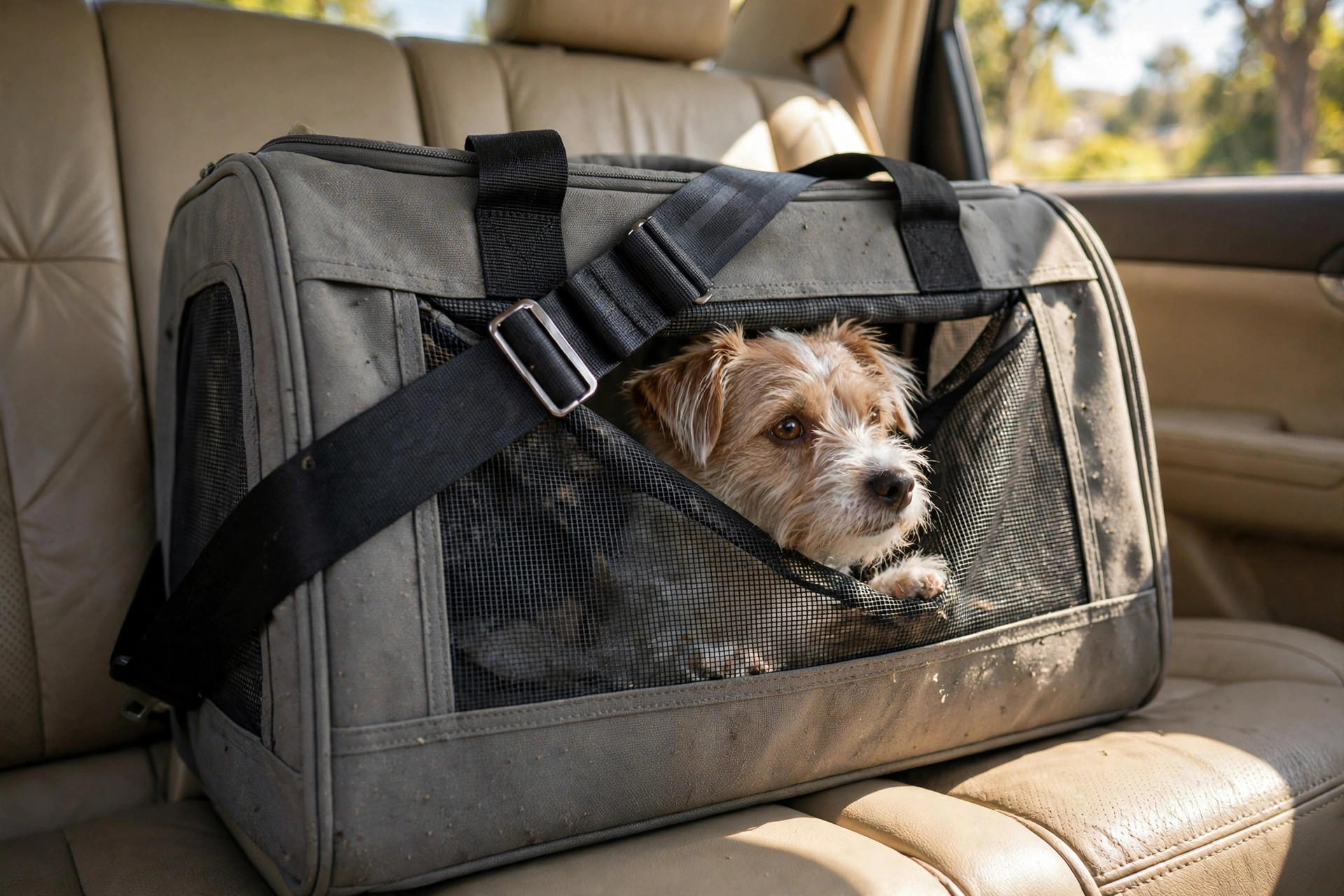
Look for a seatbelt loop, a strap slot, or an interior tether clip that lets you thread the car's seatbelt through or around the carrier. Place the carrier on the back seat (never the front seat, where an airbag can injure a pet), thread the belt through, and buckle it snug so the carrier cannot slide or tip in a hard stop. A carrier that just sits loose on the seat is barely safer than no carrier at all.
2. Size it to your pet, not your car
Measure your pet standing: nose to base of tail, plus 2–3 inches of length, and floor to top of head for height. Your pet should be able to stand, turn around, and lie down comfortably inside. Check the carrier's interior dimensions — not just the outside — before ordering. Too small stresses your pet; far too big lets them slide around on every turn.
3. Ventilation and visibility calm nervous pets
Mesh panels on at least two or three sides give airflow and let your pet see you, which settles most cats and dogs far better than a dark, closed box. Never leave a pet in a parked car, and keep the air conditioning pointed toward the back seat on long drives.
4. Loading should not be a fight
Top-loading carriers and carriers with three entry points let you lower your pet in gently. Practise at home first: leave the carrier open with familiar bedding and treats inside for several days, then try short sessions with the door closed and a short drive around the block. The ASPCA's travel safety tips are a solid pre-trip checklist, and the AKC's travel guides cover travelling with pets in more depth.
5. An honest note on "crash-tested" claims
None of the four carriers below is CPS crash-tested or crash-certified, and we will not pretend otherwise. Genuine crash-tested crates (brands like Sleepypod and Gunner) are a different, much pricier category built and tested like child car seats. What these four offer is honest seatbelt-secure travel: a sturdy carrier, strapped to the back seat, that keeps your pet contained and protected in normal driving and hard braking. For everyday road trips, vet runs, and holidays, that is exactly the right level of protection — and far safer than a loose pet or a pet on a lap.
The 4 best pet carriers for car travel in 2026
Henkelion Soft-Sided Pet Carrier
- Lightweight, foldable soft-sided design — easy to carry and store
- Airline-friendly sizing with mesh panels for ventilation and visibility
- Adjustable shoulder strap and a price that is hard to argue with
As an Amazon Associate, CalcPet earns from qualifying purchases.
The Henkelion is the best-selling soft-sided carrier on Amazon for a reason: it nails the fundamentals at a price that makes it an easy first carrier. In the car it shines because it is light enough to carry one-handed from house to back seat, folds flat into the trunk between trips, and the mesh sides give good airflow and a view, which helps many cats settle on long drives. It fits pets up to 15 lbs and sits neatly on a back seat with the seatbelt threaded through. The lightweight build is not for determined scratchers, and larger cats will want the roomier picks below.
Pros: very affordable; lightweight and portable; folds flat; solid for calm cats.
Cons: not for heavy chewers/scratchers; snug for larger cats; minimal padding.
Best for: budget buyers, calm small cats, and first-time road trippers who want a proven, affordable carrier.
Petsfit Expandable Cat Carrier, Airline Approved
- Side panels unzip to expand floor space — stretch room at the gate or in the car
- Airline-sized footprint that fits under most seats when zipped up
- Self-locking zippers, interior safety tether, and a washable plush mat
As an Amazon Associate, CalcPet earns from qualifying purchases.
Long drives are where expandable carriers earn their keep. Zipped up, the Petsfit is a compact bag — roughly 17 x 11 x 11 in — that sits securely on the back seat with the seatbelt on. At a rest stop, unzip the side extensions and your cat gets real room to stretch, eat, and settle without ever leaving the carrier. The interior safety tether clips to a harness so your cat cannot bolt when you open a panel, and the washable plush mat handles the inevitable accident. Keep the expansions zipped shut while the car is moving, and note the expanded sections are soft mesh, not rigid structure, so it suits calm to medium-energy travellers best.
Pros: extra room exactly when it matters; compact footprint on the seat; good ventilation; doubles as a travel den.
Cons: expanded sections are soft mesh, not rigid; best for cats up to the stated weight limit — measure first.
Best for: long road trips, rest-stop breaks, and cats that hate feeling boxed in.
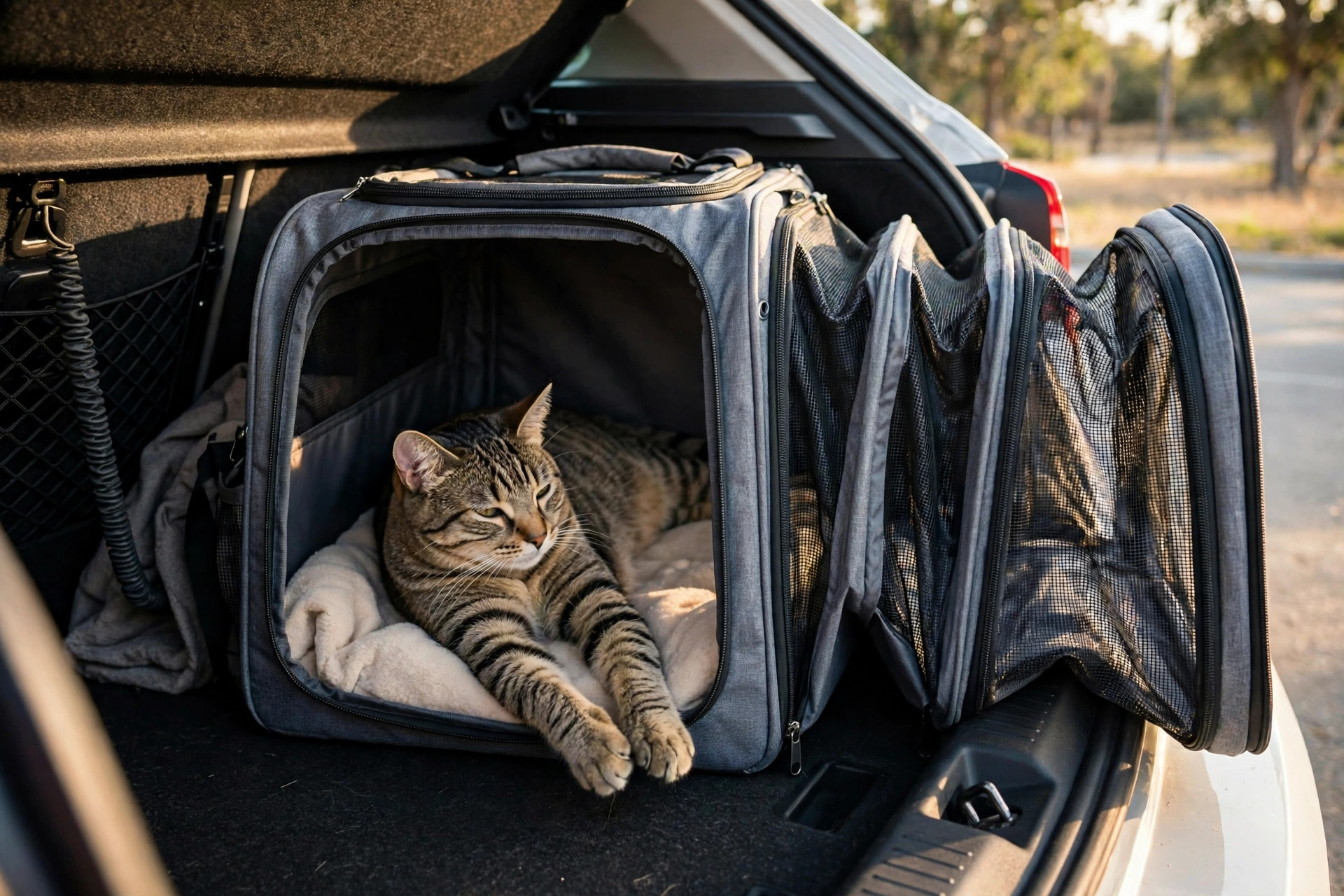
Morpilot Soft-Sided Pet Carrier for Large Cats
- Locking zippers plus an interior safety buckle — built for determined escape artists
- Roomy boxy shape with real headroom; rated for cats up to 25 lbs
- Three entry points (top, front, back) and a removable washable cushion
As an Amazon Associate, CalcPet earns from qualifying purchases.
If your cat treats zippers as a puzzle to solve, this is the carrier to beat. The locking zippers and interior safety buckle are made for strong, clever cats, and the tall, boxy shape gives bigger cats genuine headroom — rated for cats up to 25 lbs, the only pick here that comfortably handles a large cat. Three separate openings mean you never force a cat through a single small door, and it folds flat with a washable cushion for storage between trips. The trade-off: because it is built roomy, check that it fits your back seat comfortably alongside other passengers or gear before a long drive.
Pros: genuinely escape-resistant hardware; spacious for large cats; multiple entry points; folds flat.
Cons: fabric shows pet hair; bulkier than ultra-light carriers; overkill for tiny kittens.
Best for: strong, clever, or anxious cats that have defeated lesser carriers — and large cats that need real headroom.
Petmate Two Door Top Load Kennel
- Top AND front doors — lower your cat in instead of pushing them through
- Sturdy hard-sided shell with 360-degree ventilation slots
- Steel-wire front door with secure latch; easy to hose down and clean
As an Amazon Associate, CalcPet earns from qualifying purchases.
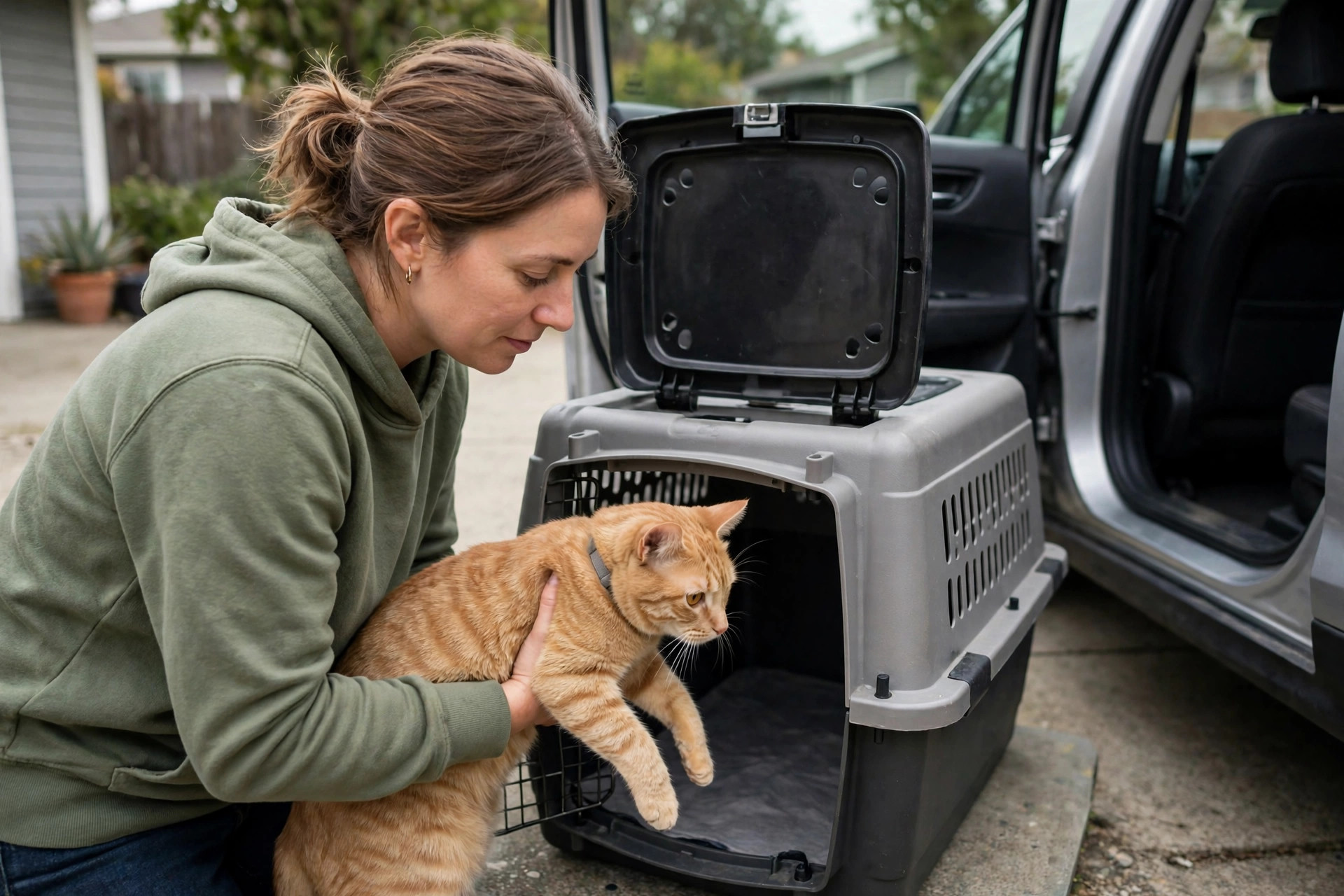
The Petmate earns its place by solving the number-one carrier complaint: loading. The top door lets you gently place an unwilling cat inside, and the hard shell holds its shape on the back seat no matter how much luggage presses against it — soft carriers can sag under a heavy bag, but this one will not. The shell is solid, cleans up in seconds after accidents, and the steel-wire front door latches firmly. It is a basic, no-frills design with no included padding, so add a small blanket or mat for comfort, but as a sturdy, easy-to-clean car carrier it is the practical workhorse pick.
Pros: top loading removes the biggest stress point; durable and easy to clean; secure steel-wire door; great value.
Cons: basic looks; no included padding; bulkier to store than soft carriers.
Best for: nervous cats, frequent vet visits, and owners tired of the loading wrestling match.
Pet carrier comparison table
| Carrier | Award | Type | Standout feature | Best for |
|---|---|---|---|---|
| Henkelion Soft-Sided | Best Overall | Soft-sided | Light, foldable, ~18,334 ratings | First-time road trippers, budget buyers |
| Petsfit Expandable | Best Expandable | Soft-sided | Unzips into extra room | Long drives, rest stops |
| Morpilot Soft-Sided | Best Escape-Proof | Soft-sided | Locking zippers, 25-lb rating | Large or escape-prone cats |
| Petmate Two Door Top Load | Best Hard-Sided | Hard-sided | Top + front doors | Anxious cats, vet visits |
Setting up the car for a calm ride
Secure the carrier with the seatbelt before you load your pet, point a vent toward it so air reaches the mesh panels, and pack water, a collapsible bowl, treats, waste bags, and a spare towel. Stop every two to three hours on long drives so your pet can stretch, drink, and use a litter tray. Never feed a big meal right before departure, and never leave a pet alone in a parked car, even with the windows cracked.
Our verdict
If we had to pick one carrier for the widest range of cats and car trips, it would be the Henkelion — the best-selling soft-sided carrier in its class, light enough to carry all day, and sized to sit neatly on a back seat. Drivers planning long road trips with rest stops should look hard at the Petsfit Expandable, because the extra room at a stop is genuinely calming. Owners of large or escape-prone cats need the Morpilot, and anxious cats will do best with the top-loading Petmate — just add a soft mat inside for comfort.
Whichever you choose, the real secret to a calm drive is the introduction: leave the carrier out, make it cozy, and let your pet claim it as a safe spot days before travel day. Pair that with our holiday pet travel checklist and our guide to carriers for air travel if your trip involves a flight too.
Frequently asked questions
Should my cat ride in a carrier in the car?
Yes. A carrier keeps your pet in one safe place, prevents them from climbing into the driver's lap or under the pedals, and protects them in a sudden stop. The carrier should sit on the back seat, secured with the seatbelt, never loose on the seat or in the front passenger seat.
How do I secure a pet carrier with a seatbelt?
Place the carrier on the back seat, thread the seatbelt through the carrier's strap loop or around the carrier body, and buckle it snug so the carrier cannot slide or tip. Give the carrier a firm shake — if it moves more than an inch, tighten it.
Are any of these carriers crash-tested?
No. None of the four carriers in this guide is CPS crash-tested or crash-certified, and any listing that implies otherwise should be treated with suspicion. Genuine crash-tested crates are a separate, much pricier category. These four provide honest seatbelt-secure travel, which is a big safety step up from a loose pet.
Soft-sided or hard-sided carrier for car travel?
Soft-sided carriers are lighter, fold flat for storage, and flex slightly to fit a crowded back seat. Hard-sided carriers hold their shape under luggage, are easier to clean after accidents, and suit cats that scratch through fabric. Many owners end up with one of each — soft for quick trips, hard for longer drives.
How long can my cat stay in the carrier on a road trip?
Plan a stop every two to three hours so your cat can stretch, drink water, and use a litter tray. On very long drives, an expandable carrier like the Petsfit gives extra room at rest stops without ever letting your cat roam the car.
What size carrier does my cat need for the car?
Measure your cat standing: nose to base of tail plus 2–3 inches for length, floor to top of head for height. Your cat should be able to stand, turn around, and lie down inside. Check the carrier's interior dimensions against those numbers.
The bottom line
A good car carrier does more than transport your pet — it changes how your pet feels about travelling entirely. Pick the design that matches your cat and your car, secure it properly to the back seat, introduce it patiently at home, and keep a travel checklist handy. For more gear, browse our Pet Parent Picks — and before your next trip, try our dog age calculator to check whether your travel companion counts as a senior who needs extra stops and comfort.