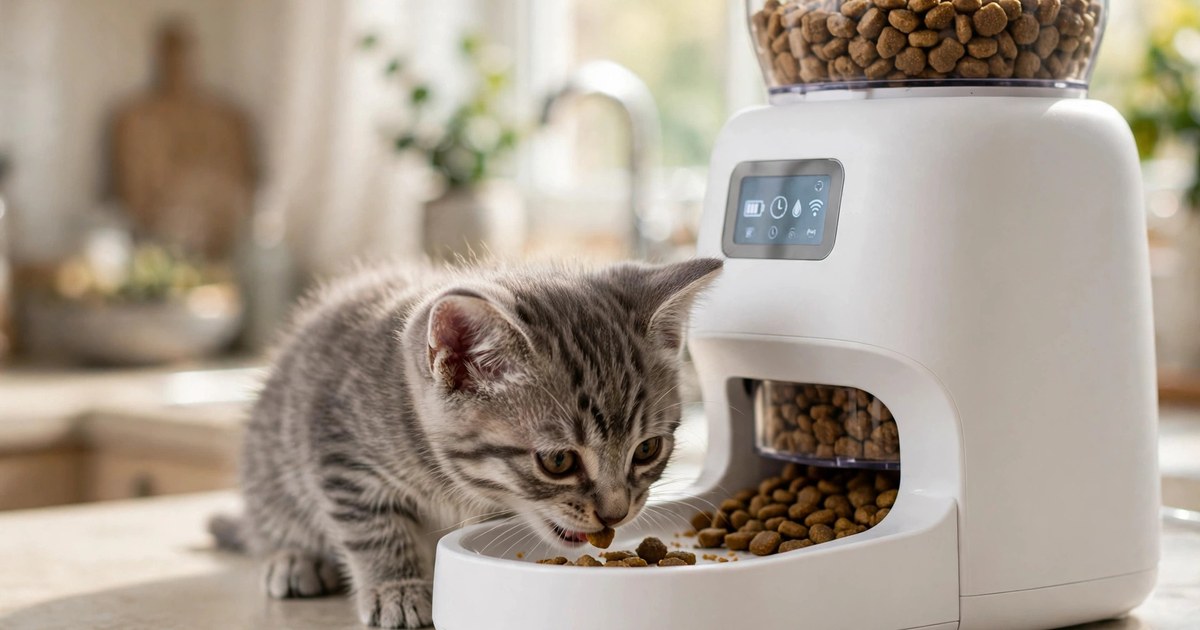
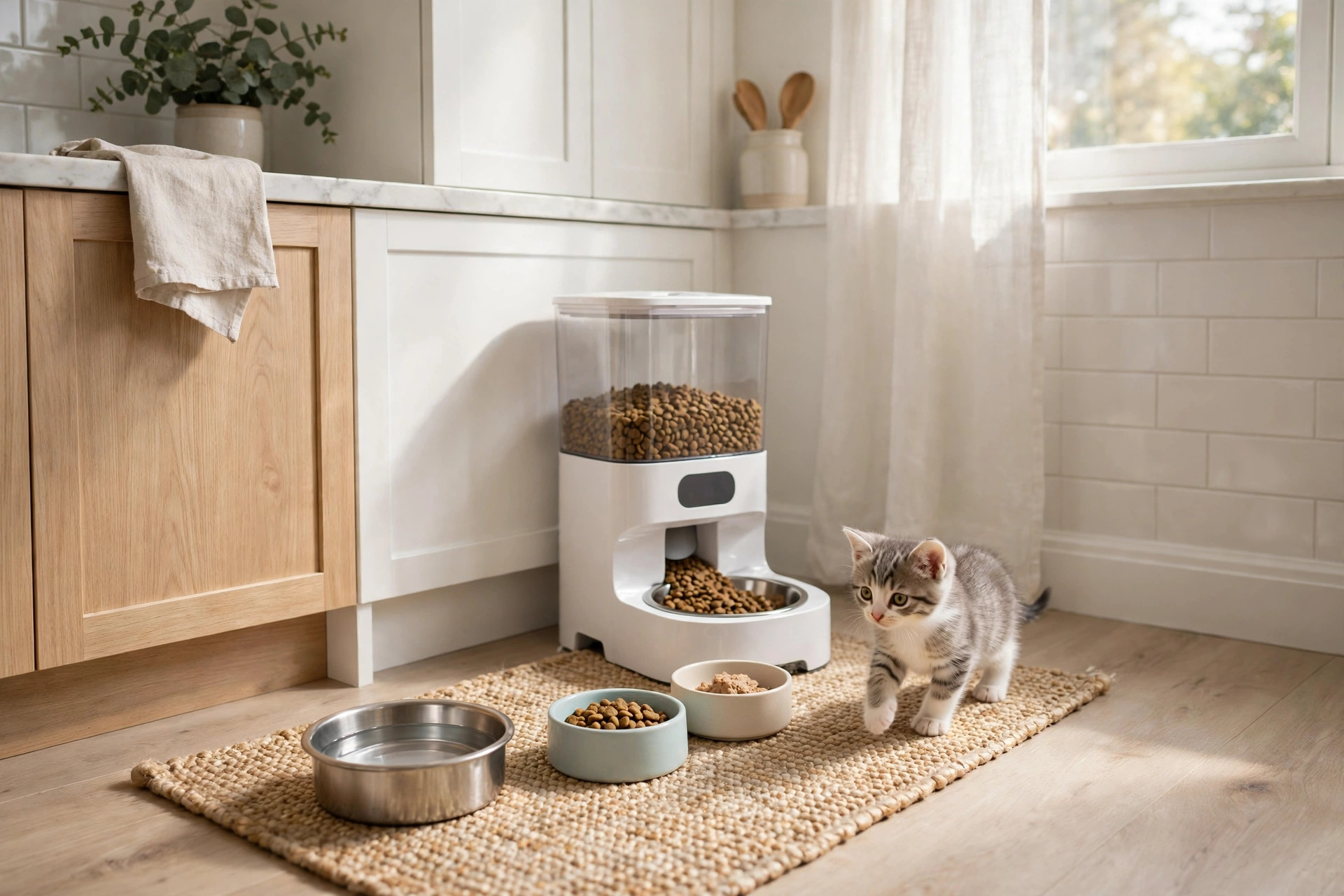
A new kitten eats like a tiny clock: little and often. Three to five small meals a day is the usual pattern for a young kitten, and that is exactly where an automatic feeder earns its keep. It drops a measured portion on schedule, even when you are at work, asleep, or stuck in traffic — and the best ones do it quietly enough not to startle a small cat that is still learning your home.
But not every feeder suits a kitten. Some dispense portions far too big for a small stomach. Some are loud enough to send a nervous kitten hiding under the sofa. And most hopper feeders only handle dry kibble, which matters when your kitten is still on a mixed diet. This guide rounds up five feeders that genuinely work for kittens, with honest notes on who each one is — and is not — for.
Disclosure: CalcPet is reader-supported. As an Amazon Associate, CalcPet earns from qualifying purchases made through the links in this article, at no extra cost to you. Ratings quoted are the products' Amazon ratings as listed; we have not tested these feeders ourselves.
Our Top 3 at a Glance
- Best Overall — PETLIBRO Granary WiFi Feeder: app scheduling up to 10 meals a day, 5L hopper, and the biggest review base in this roundup.
- Best with Camera — PETLIBRO Camera Feeder: 1080p camera with night vision, so you can check your kitten actually showed up to eat.
- Best No-App Pick — PetSafe 6-Meal Feeder: six timed compartments, no Wi-Fi, no account, battery-powered — the simple option that just works.
What Makes a Feeder Good for a Kitten?
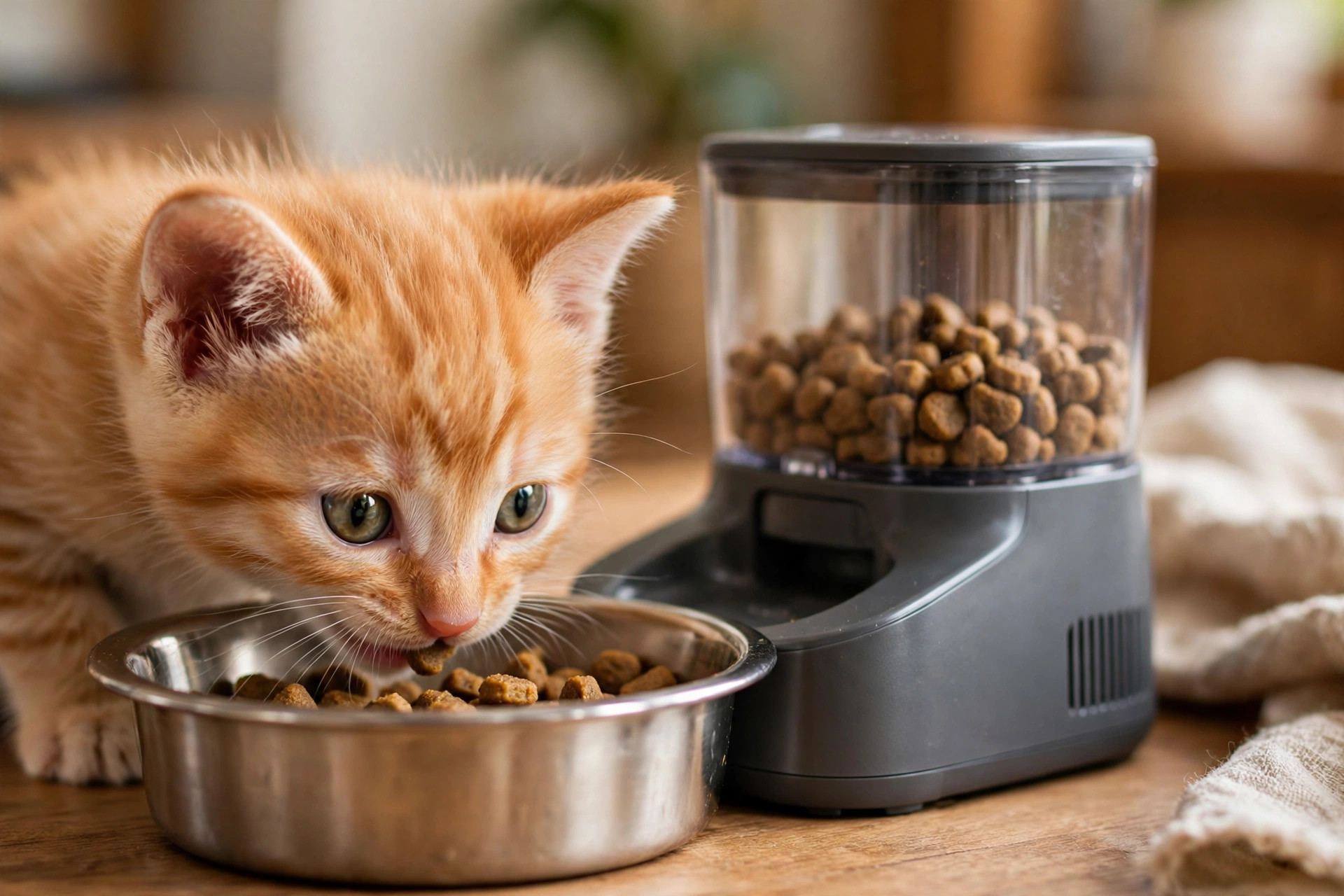
Kittens are not small cats when it comes to feeding — they eat differently, and the feeder has to match. Before you compare models, here is the checklist we used to judge every pick in this roundup.
1. Small, precise portions
A kitten's meal is measured in tablespoons, not cups. Look for feeders that dispense in small increments — the PetSafe Smart Feed, for example, goes down to 1/8-cup portions. A feeder that only drops big scoops will overfeed a kitten or leave most of the portion sitting in the bowl.
2. Four or more meals a day
Kittens do best on three to five small meals spread through the day. Any feeder you buy should schedule at least four meals daily. Every pick below manages that, and most manage far more.
3. Quiet operation
A loud motor or a clunking dispenser can put a shy kitten off its food entirely. Quiet, smooth dispensing matters more for a kitten than for a confident adult cat. If your kitten is nervous, introduce the feeder while it is off first, and let the kitten sniff it before the first scheduled meal drops.
4. The right kibble size
Automatic feeders are built for dry kibble of a certain size. The PETKIT feeder, for instance, needs kibble under 12mm to dispense reliably, and the WOPET dual feeder takes 2–12mm kibble. Check your kitten's kibble against the feeder's limit before you buy — oversized kibble is the most common cause of jams.
5. A low, easy bowl
A kitten is short. A deep bowl or a high rim makes eating awkward and can put a small cat off. The feeders below all dispense into low, open bowls a kitten can reach comfortably.
6. Wet food is a separate problem
Be honest with yourself here: hopper feeders are dry-kibble only. If your kitten eats wet food, no hopper feeder will handle it. The only pick below that tolerates wet food at all is the PetSafe 6-Meal tray feeder, and only for short stretches — a few hours, not all day. For wet-food meals, you will still be serving by hand.
The 5 Best Automatic Feeders for Kittens in 2026
PETLIBRO Granary Automatic Pet Feeder (WiFi, 5L)
- 5L hopper with 5G/2.4G Wi-Fi app control — up to 10 meals per day
- Freshness preservation with desiccant bag plus low-food sensor alerts
- Twist-lock lid keeps clever paws out of the food hopper
As an Amazon Associate, CalcPet earns from qualifying purchases.
The Granary is the most flexible feeder in this roundup, and flexibility is exactly what a kitten's changing routine needs. Ten meals a day through the app means you can start with five tiny meals and taper down to three or four as your kitten grows, without buying a new feeder. The 5L hopper is far bigger than a kitten needs — one fill lasts weeks at kitten portions — so keep an eye on freshness and do not let kibble sit in the hopper for a month. The twist-lock lid is a genuine plus with kittens: curious paws will try to pry a feeder open, and this one stays shut. The low-food sensor alerts you in the app before the hopper runs dry, which is the kind of small safety net new kitten owners appreciate.
Pros: Huge review base (~10,000 ratings) for a feeder in this range; flexible app scheduling suits shift workers and travelers; made for both cats and small-to-medium dogs; 24-month warranty.
Cons: Wi-Fi setup can be fiddly on 5G-only networks; replacement desiccant bags are an ongoing cost; dry kibble only — no wet food support.
Best for: App-controlled scheduled feeding for cats and small dogs. Not for: owners who want a feeder with no app at all, or a wet-food solution.
PetSafe Smart Feed Automatic Pet Feeder (6L)
- Large 6L (24-cup) hopper — fewer refills per week
- Schedules up to 12 meals/day, 1/8 to 4 cups per meal
- Slow-feed mode dispenses over 15 minutes; works with Alexa
As an Amazon Associate, CalcPet earns from qualifying purchases.
The Smart Feed earns its place here on portion control. Its smallest portion is 1/8 of a cup — small enough for a kitten's meal — and it schedules up to 12 meals a day, so you can split the day's food into as many tiny servings as you like. The slow-feed mode, which stretches one meal over 15 minutes, is genuinely useful for kittens that bolt their food and then look for more. Two honest caveats: the 6L hopper is built for large dogs, so it is far more capacity than a kitten needs, and its footprint is the bulkiest in this roundup. At kitten portions, one fill lasts a very long time — keep the kibble fresh and do not fill it to the top. But if precise portions matter most to you, this is the most precise feeder here.
Pros: Big capacity suits large dogs; handles dry and semi-moist kibble without jamming; from PetSafe, a US pet brand established in 1998.
Cons: Bulky footprint on the counter; some owners report app connectivity hiccups; smaller review base than the category leaders.
Best for: Owners who want the finest portion control in this roundup. Not for: small kitchens, or anyone who wants a compact feeder.
PETLIBRO Automatic Cat Feeder with Camera (1080p)
- 1080p HD camera with night vision and 2-way audio
- Stainless steel slow-feed tray; app scheduling with motion alerts
- #1 ranked in Automatic Cat Feeders on Amazon
As an Amazon Associate, CalcPet earns from qualifying purchases.
New kitten owners worry most about one thing: did the kitten actually eat while I was out? This is the feeder that answers that question. The 1080p camera with night vision and two-way audio lets you watch mealtimes from your phone, and motion alerts tell you when your kitten approaches the bowl. The stainless steel slow-feed tray suits kittens that eat too fast, and the ~11,700-rating review base is the strongest in this roundup. Two things to know: the hopper is smaller than the Granary's 5L, so you will refill it more often, and the camera needs stable Wi-Fi — if your connection drops, you lose the live view (scheduled feeding keeps working). It is also the priciest pick here, so buy it for the camera, not just the feeding.
Pros: Check in on pets visually at mealtimes, day or night; slow-feed tray design suits fast eaters; strong rating base (~11,700 ratings).
Cons: Priciest option in this roundup; camera features need a stable Wi-Fi connection; single tray — not ideal for two cats.
Best for: Owners who want to watch their pets at mealtime. Not for: two-kitten households, or anyone on a tight budget.
PETKIT Automatic WiFi Pet Feeder
- Remote app control with feeding records and portion tracking
- Fresh-lock sealing with desiccant keeps kibble fresh longer
- 304 stainless steel bowl; ~15 days of food for one adult cat
As an Amazon Associate, CalcPet earns from qualifying purchases.
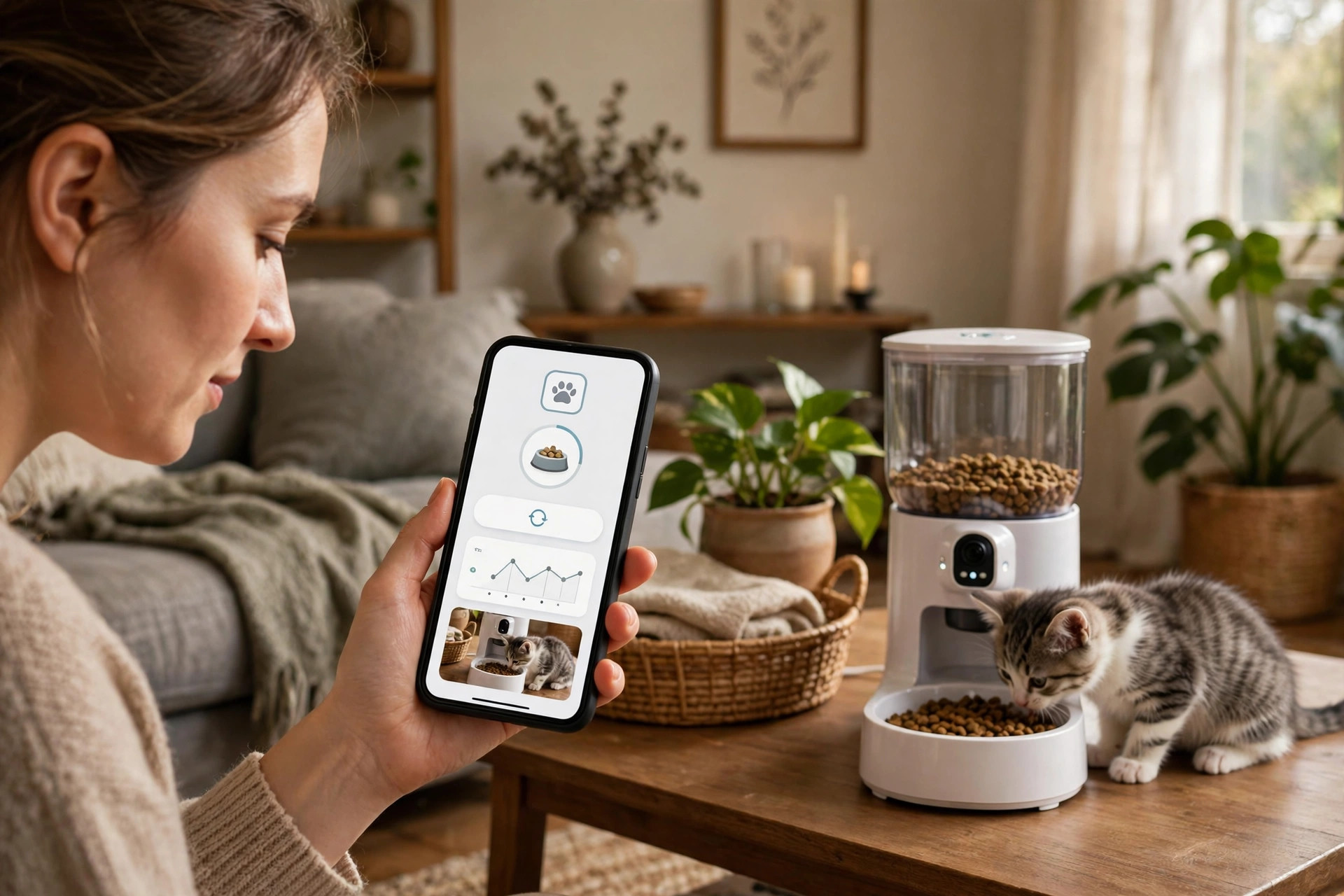
The PETKIT is the record-keeper of the group. Its app logs every meal — when it was served and how much — so you can see at a glance whether your kitten ate on schedule while you were away. That feeding history is genuinely useful in the first weeks, when you are still learning your kitten's appetite. The fresh-lock sealing and desiccant keep kibble fresh, and the 304 stainless steel bowl is easy to clean. The capacity figure needs context: ~15 days of food is measured for one adult cat, so at kitten portions the hopper lasts considerably longer — do not fill it to the top and forget about it. The hard limit is kibble size: it must be under 12mm to dispense reliably, so check your kitten's kibble before you buy. It is also 2.4GHz Wi-Fi only, and it sits at a premium price next to basic timed feeders.
Pros: Detailed feeding history in the PETKIT app; hygienic stainless bowl helps avoid chin acne; pet-proof top lock defeats sneaky paws.
Cons: 2.4GHz Wi-Fi only (no 5GHz); premium pricing vs. basic timed feeders; kibble must be under 12mm to dispense reliably.
Best for: Tech-friendly owners who want detailed feeding records. Not for: owners with 5GHz-only Wi-Fi, or large-breed kibble.
PetSafe 6 Meal Automatic Pet Feeder
- 6 timed compartments plus 1 always-open tray
- Digital clock timer — no Wi-Fi or smartphone needed
- Tamper-resistant locking lid; dishwasher-safe trays
As an Amazon Associate, CalcPet earns from qualifying purchases.
Sometimes the best tool is the simplest one. The 6-Meal feeder has no app, no account, no Wi-Fi and no updates — you set the clock, fill six compartments, and it opens one on schedule. That simplicity is a real advantage with kittens: there is nothing to configure wrong, and the battery power means it keeps working in a power cut. Each compartment holds 1 cup, which is a full meal for many kittens, and the always-open tray gives your kitten something to nibble between scheduled meals. It is also the only feeder here that tolerates wet food at all — a tray of wet food is fine for a few hours, though not all day. The trade-off is flexibility: six scheduled meals is the maximum, and you cannot change portion size within a meal. For a weekend away or a straightforward daily routine, though, it is hard to beat.
Pros: Dead simple: no accounts, no apps, no updates; great for short trips and weekends away; battery-powered — keeps working in power cuts.
Cons: Only 6 scheduled meals maximum; 1 cup per compartment limits very large dogs; no portion flexibility within a single meal.
Best for: Simple, reliable timed meals without an app. Not for: owners who want remote control, or more than six meals a day.
Quick Comparison
| Feeder | Rating | Meals / day | Best for |
|---|---|---|---|
| PETLIBRO Granary WiFi | 4.1/5 · ~10,000 Amazon ratings | Up to 10 | Best Overall |
| PetSafe Smart Feed | 4.0/5 · ~2,100 Amazon ratings | Up to 12 | Precise portions |
| PETLIBRO Camera Feeder | 4.2/5 · ~11,700 Amazon ratings | App-scheduled | Camera check-ins |
| PETKIT WiFi Feeder | App-controlled feeder · ~15-day food capacity | App-scheduled | Feeding records |
| PetSafe 6-Meal Feeder | Classic no-WiFi timed feeder · PetSafe quality | 6 + always-open tray | No-app simplicity |
Setting Up Your Kitten's Feeding Routine
A feeder only helps if the routine around it is right. Here is a simple setup that works for most kittens.
- Start with four small meals a day. Morning, midday, evening and a small bedtime meal is a good starting pattern. You can adjust the times in the app as your kitten settles in.
- Measure the portion, don't guess it. Start small — a few tablespoons per meal — and watch whether the bowl is empty or has leftovers. Adjust one meal at a time, not all of them at once.
- Introduce the feeder while it is off. Let your kitten sniff the feeder and eat from its bowl for a day or two before the first automatic drop. A kitten that is already comfortable with the bowl will not be startled by the sound.
- Keep fresh water beside it, not in it. A feeder handles food; water needs its own bowl or fountain nearby. If you want a fountain too, see our guide to the best pet water fountains for kittens.
- Clean the bowl and hopper weekly. Kittens are messy eaters, and old kibble dust builds up fast. The stainless bowls in this roundup wipe clean in seconds, and the PetSafe 6-Meal trays are dishwasher-safe.
- Watch the first week closely. Check that your kitten is actually eating each scheduled meal — the camera feeder makes this easy, and the PETKIT app's feeding records do the same job. If a meal is regularly skipped, the portion or the timing needs adjusting.
What if you have two kittens?
If two kittens share your home, one feeder usually means one kitten eats and the other waits. The WOPET Automatic Cat Feeder for Two Cats is built for exactly this: dual stainless steel bowls that feed two cats at once, a programmable timer for up to 6 meals per day, and a 10-second voice recording that plays a meal call. It runs on a simple LCD setup with no app or account, and it takes 2–12mm dry kibble. It was not one of the five card picks here because it is a two-cat specialist, but for a two-kitten household it is the more sensible buy than two separate feeders.
Verdict: Which Feeder Should You Buy?
For most kitten owners, the PETLIBRO Granary is the safest buy: ten meals a day, app control, a big hopper and the largest review base in this roundup. If you are away from home a lot and want to see your kitten eat, the PETLIBRO Camera Feeder is worth the extra cost for the camera alone. If you hate apps and just want meals to happen on time, the PetSafe 6-Meal Feeder does the job with zero setup fuss — and it is the only one here that handles a tray of wet food for a few hours. The PetSafe Smart Feed is the pick for owners who care most about exact portions, and the PETKIT is for owners who want a written record of every meal.
Whichever you choose, remember the feeder is only half the routine. Small portions, a regular schedule, fresh water nearby and a quick weekly clean matter more than any single feature. Get those right and your kitten will settle into its meals within days. For more kitten help, see our automatic feeders for puppies guide if you also have a young dog, our best automatic cat feeders roundup for when your kitten grows up, and our feeders for senior cats for the other end of life. You can browse every pick in one place on our Pet Parent Picks page, and our guide to kibble vs wet food scheduling with automatic feeders covers the wet-food question in detail.
FAQs
Can kittens use an automatic feeder?
Yes — as long as the feeder dispenses small enough portions and schedules enough meals. Look for 1/8-cup increments and at least four meals a day. Introduce the feeder while it is switched off first, so your kitten gets comfortable with the bowl before the first automatic drop.
How many meals a day should a kitten get from a feeder?
Three to five small meals a day is the usual pattern for a young kitten. All five feeders in this roundup can schedule at least four meals, and the PETLIBRO Granary and PetSafe Smart Feed manage ten or more, so you can taper the frequency down as your kitten grows.
Can an automatic feeder dispense wet food?
Hopper feeders cannot — they are dry-kibble only. The PetSafe 6-Meal tray feeder is the exception: its compartments can hold wet food for a few hours, which covers one meal while you are out, but wet food should not sit in it all day. For the rest, serve wet food by hand.
What kibble size works in an automatic feeder?
It depends on the model. The PETKIT feeder needs kibble under 12mm, and the WOPET dual feeder takes 2–12mm kibble. Always check your kitten's kibble against the feeder's stated size limit — oversized kibble is the most common cause of jams.
Do I need a camera feeder for a kitten?
Not strictly, but it is the most reassuring option for new owners. A camera lets you confirm your kitten actually ate while you were away, which is hard to verify any other way. If you are home most of the day, a simpler feeder like the PetSafe 6-Meal does the same feeding job for less.
What if I have two kittens?
Buy a feeder built for two. The WOPET dual feeder has two stainless steel bowls that serve both kittens at once, with up to six meals a day and a voice-recording meal call. A single-bowl feeder usually ends with one kitten eating first and the other waiting.
Conclusion
A kitten's feeding routine is small meals, on time, every day — and that is exactly what a good automatic feeder delivers. Pick the Granary for flexibility, the camera feeder for peace of mind, the 6-Meal for simplicity, the Smart Feed for exact portions, or the PETKIT for a written record of every meal. Set it up slowly, keep the portions small, and keep fresh water nearby. Curious how old your kitten is in human years? Try our free cat age calculator — and if you want more feeding guidance, the ASPCA's cat nutrition tips and general cat care guide, plus International Cat Care's feeding your cat or kitten guide, are solid places to start.